Is Brisket a National Security Issue?
Episode Details
Transcript
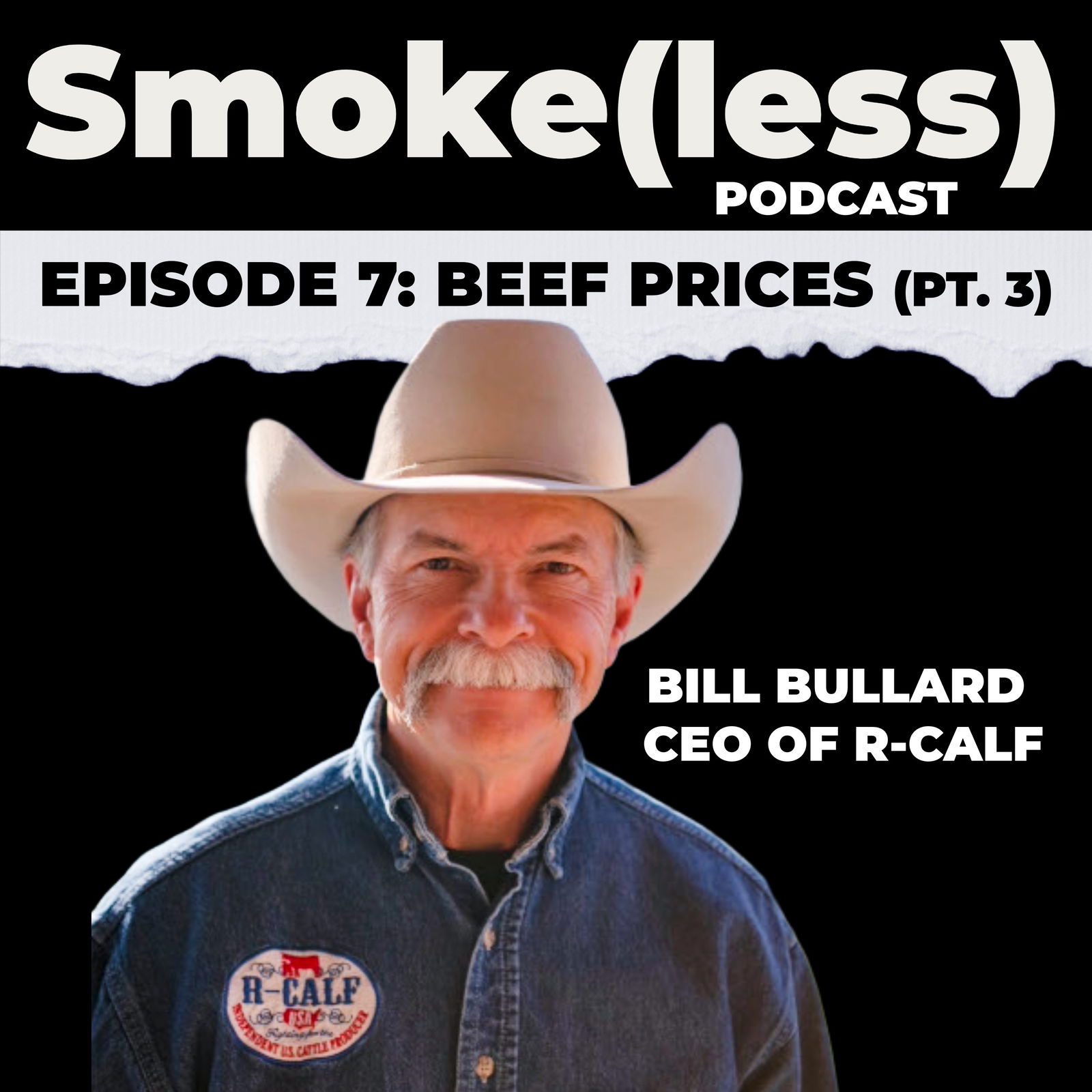
In this episode of Smoke(less), we sit down with Bill Bullard, CEO of R-CALF USA, to talk about the 2026 beef crisis — and why the conversation isn’t just about price tags.
Bill breaks down how power and concentration in the beef system shapes everything from what ranchers earn to what consumers pay, the role imports and labeling play in the modern market, and why he believes food production belongs in the same conversation as other critical national interests.
If you care about BBQ, brisket, and the future of beef in America, this one will make you think.
Drop a comment with your thoughts — is the beef industry heading in the right direction, or are we watching a system crack in real time?
Speaker 0
This industry has been in a state of crisis for a long time. The markets have been functionally broke. Speaker 1
Cattle ranchers are suffering. We're hearing that the big four packers are suffering major losses and closing down production facilities. Something doesn't quite add up because we've got all these high prices and every point in the cycle people are saying that they're suffering in the supply chain. Speaker 0
And this is a national security issue. We have been quickly replacing our domestic production capacity with imported product, leaving us vulnerable and dependent on foreign countries for the most important protein staple in the United States from our perspective. Speaker 2
Hey, everybody. Welcome to Smokeless. I'm Nick. As always, we're here with Justin and Wayne. Today, we're joined by a special guest, Bill Bullard, who is the CEO of RCAF. RCAF stands for Ranchers Cattlemen Action Legal Fund. Bill is a former cattle rancher. He has also got some regulatory experience, in the state of South Dakota with the Public Utilities Commission. Bill, welcome to Smokeless. Speaker 0
Glad to be here. Thank you. Speaker 3
Here in Texas, barbecue is a religion of and it's one of our foundational tenets of our culture, and brisket is is probably the main flag for that cuisine. So what happens in the beef industry deeply affects us. I don't know if you've if you caught what our agriculture commissioner, Sid Miller, has said over the last, I would say, three or four days right before the weekend, about he's calling for emergency action to be taken to save this our our national treasure in Texas, our barbecue. Speaker 0
I've been watching that closely. Yes. Speaker 3
Tell me what you think about his his points on these are the what we feel are the hinge issues that need to be addressed, and by doing so that, you know, we think we can at least stabilize pricing, if if not bring that down somewhat. Any thoughts on that? Speaker 0
So so please tell me specifically what are the points, and I will Sure. Then I can address those. Speaker 3
In his release, he talked about, one, offering a federal heifer retention tax credit. You know, I I guess that's what some of what I'm hearing potentially says that profit incentive is is is driving ranchers to sell off some of their breeding stocks, some of their breeding heifers. Possibly, this will be a way to subsidize them, to retain them, to help build the herd, which I guess is at, what, seventy five year lows? Correct. The second point is rebuild, take the initiative to rebuild the domestic herd before we start importing, which I'm interested on your input there, especially does that help short term, midterm, long term? What are the effects there? Expand drought relief and and grazing access, I'm I'm assuming, on on public lands, granting more access. The fourth is to strengthen market transparency through through, legislation and labeling, and enforce particularly the mandatory country of origin labeling, regarding imported beef. That's, right now, his initial prescription. What do you think about that? Speaker 0
Well, I I think it's a good start. So ours is an industry that has never relied on government price supports in order to determine our production levels. We would expand and contract the herd based on pricing signals from the industry, from the consumers. And this had created what we call a cattle cycle, And it typically lasts ten to twelve years, and you'd see six to seven years of herd expansion as beef prices increased and consumer demand increased. And then you would see the herd withdraw. It would begin to liquidate for three to four years in response to lower lower, beef prices and lower beef demand. And so we reach an equal, imbalance in equilibrium again, and then we go right back to the cycle for another ten to twelve years. So, we're not in favor of government subsidy subsidies, in order to correct what has been a decades long contraction, a fast deterioration of our US cattle industry, and it's the result of failed public policies, failure to to, enforce our antitrust laws, failure to enforce the Packers and Stockyards Act, failure to maintain mandatory country of origin labeling for beef that was in effect from two thousand and thirteen to two thousand and fifteen. And so the problems that we face today are long term chronic problems that have recently been illuminated because of a tight supply situation and, many of the decision makers cite the widespread drought that we had in the two thousand twenty two period and the closure of the Mexican border, both of which have accelerated the ongoing decline of the industry. So from our perspective, of those items that you listed, number one, we need to begin managing trade because trade has enabled the highly concentrated meatpackers to leverage down domestic cattle prices. And increasing imports at this time as a means of reducing the the price of beef, has historically proven, impossible because we have such a highly concentrated industry. We've got four packers controlling eighty to eighty five percent of the fed cattle market and eighty percent of the box beef market. So this level of concentration means that we're marketing into what's called a tight oligopoly, and it's far in excess. It's four firm concentration rate of four firms controlling eighty percent. That's far in excess of levels that are known to elicit poor economic performance and anticompetitive conduct or behavior in the marketplace. We must address that. We must enforce our antitrust laws, and we must enforce the Packers and Stockyards Act, which which is a separate and additional additional law that was designed to provide protections to independent livestock producers who unfortunately have to market into this highly concentrated industry. So the the item suggesting that we, build the US herd before we rely on imports, presents, is exactly the right way to to go about this. But we have to recognize that we under produce for the domestic market and we've had for the past at least the past four decades, which means that if we, were to curtail imports completely, we would see, a significant shortage in the United States. So we need to provide a space for our domestic industry to rebuild. And in order to do that, we need to have quotas on these imports from around the world. We're importing from twenty different countries. So we need quotas on the imports in order to provide, relief and space for our domestic industry to rebuild so the packers can't bring in these cheaper undifferentiated imports without country of origin labeling and displace our domestic production because these imports are therefore a perfect substitute for our domestic production. So, so we fully agree with that expanding opportunities for grazing on public lands like you said. We know USDA and the Department of Interior are working on plans to do just that. That's exactly what we need to do. We're also asking USDA to look at these conservation reserve acres, CRP. We know that there are grassland CRPs that make up less than half of the total acreage, that's set aside, and we need we think we should open those up for grazing opportunities too because our industry has shrunk at an alarming rate, and we've lost over fifty percent of all the cattle producers that were in business just a little over a generation ago in nineteen eighty. They're gone today. We've lost fifty two percent of our cattle producers, and we've lost nine and a half million of our mother cows out of our herd. And so this industry has been in a state of crisis for a long time. The markets have been functionally broke, and, and there's a lot of work to do. But as a result of the, contraction and the attrition in our industry, we've not attracted new entrants because we've gone through years of depressed prices and many of the young people who would otherwise aspire to get into the ranching industry, resist it because they see the, unprecedented volatility in the marketplace, a marketplace that for a long time had generated below cost of production pricing for them. So we need to reestablish confidence. So, I agree with those recommendations and especially the mandatory country of origin labeling. We believe mandatory or we believe the lack of origin information for consumers is in fact a a principle means by which the meatpackers can actually exercise the inherent market power that they possess because of their high concentration. In other words, their ability to source beef from anywhere around the world and pass it off to unsuspecting consumers as if it were produced right here in the United States under the highest production and safety standards in the world. We believe that that has had an a tremendous impact in depressing domestic cattle prices and forcing those producers out of business. Speaker 3
So Bill Speaker 0
does good answer to your pointed questions. Speaker 2
A bunch of follow ups, but just immediately to that point, does the the the voluntary labeling regulation that went into effect January one, is that does that at all counter the or satisfy the McCool labeling? Speaker 0
Well, it does not, and and here's why. What that does is create or excuse me, is correct a deceptive practice that has been going on in this industry since congress repealed mandatory country of origin labeling in late two thousand and fifteen. Since then, the packers had been able to import an exclusively foreign product. Let's say, a let's say, a brisket from Brazil. They could import that brisket from Brazil, bring it into the US, and as it crosses US customs and border protection, it will bear a label product of Brazil. But if the meatpacker then imports that product, brings it through their processing plant, removes it from the original package, and replaces it with a new package, they were allowed to put a product of USA label on that brisket that was exclusively produced in Brazil. Tremendously deceptive to consumers. That's what this new voluntary rule corrects. It no longer allows, a product to bear a US a product of USA label unless that product was derived from an animal that was born, raised, slaughtered, and processed in the United States. And so for those packers who want to voluntary voluntarily label, this is a good correction to the years' worth of problems that we that have been associated with it. But, unfortunately, it is voluntary. It doesn't require anyone to label anything, and it doesn't require or even address how do you label the imported product. And therefore, mandatory country of origin labeling is absolutely essential. We will likely see product of the USA labels under the voluntary regime coming out of small to midsize meatpackers. We're not likely to see it coming out of the global meatpackers who have found it such an so advantageous to import this undifferentiated foreign beef and pass it off as if it were a domestic product. And then to add additional complexity to this, all meat in the United States, whether foreign or domestic, will bear a USDA inspection sticker. So every meat product will have a US shield on it and leading consumers to believe it must be a domestic product, which is simply not the case at all because that shield does not denote origin. It merely denotes that it has passed inspection through our USDA food safety and inspection service. Speaker 1
So do you think the the problem is because of the imported beef? Is that the is that the crux of it? And and when when the packers import that beef, are they importing it at a lower cost than what they could purchase domestic beef for? Speaker 0
Definitely. So this imported beef, is is brought into the United States cheaper than what, our domestic production costs are here. And, the meatpackers have been increasing the volume of imports coming into the United States. And so they have been displacing not just our domestic production, but our opportunities to expand our production. And as our cattle herd has been going through these cycles throughout history, Since the early eighties, we've seen that liquidation phase has about doubled in each of the last several, cycles. Meaning, our industry has been stair stepping downward in terms of the inventory size of our cattle herd. And so as these imports have, satisfied domestic consumption of beef and demand, they have eliminated opportunities for our domestic industry to rebuild the herd. And this is a national security issue because we have been quickly replacing our domestic production capacity with imported product, leaving us vulnerable, and dependent on foreign countries for the most important beef or protein staple in the United States from our perspective, and that, of course, is beef. Speaker 1
You know, you talked about the the traditional market cycles. You know, if you if you look at the oil industry, if oil prices are increasing, the oil companies are gonna increase increase their pumping and production and drilling and try to take advantage of those price increases. And you said typically that US cattle ranchers would do the same thing. So I'm trying to understand why they haven't why are they not doing that? Speaker 0
Why isn't that happening? Okay. Speaker 1
Two two points. So one, why if if prices are at a historical high, why are we not rebuilding the herd? Why are they not incentivized to do that? And then and then two, if we're importing this, this beef at a a much lower cost, why aren't why isn't that lower cost being passed on to the consumers? Because we're hearing that the cattle ranchers are suffering. We're hearing that the big four packers are suffering major losses and closing down production facilities. Right. But something doesn't quite add up because we've got all these high prices, and every point in the cycle people are saying that they're suffering in the supply chain. Speaker 0
Right. So excellent question. And the truth is is that we should have been rebuilding our cattle herd beginning at least in early two thousand and twenty three. Mhmm. Because at that point, we had reached this the price point where it was profitable for cattle producers to expand their herd, and we would have expected the herd to expand. So this is quite alarming that now here we are in early two thousand twenty six, and we still have not begun an expansion phase of the industry. So the question is why. And a big part of that answer is because cattle producers just went through a very similar situation just a little over a decade ago. We had a widespread drought, around two thousand and ten to two thousand and thirteen. And our herd, as I've said earlier, had already been liquidating, for decades. And so we were already in a liquidation phase when the drought struck. And so in two thousand fourteen, our herd inventory fell to the lowest in seventy years, and we had incredible beef demand. So both beef prices and cattle prices increased through that period. Cattle prices in two thousand and fourteen, at the end of two thousand fourteen, hit the the then highest nominal levels in history. And the herd or the cow producers made the decision to expand. And so, soon after that, they began an expansion phase, but, inexplicably, cattle prices collapsed in two thousand and fifteen, and they collapsed further and faster than in any time in history. So those who tried to expand suddenly were faced with severely depressed prices, and many of the aspiring ranchers that got into the industry at that time had to exit. The two thousand and twenty two census shows that since that time, from two thousand seventeen to two thousand twenty two, we lost one hundred and six thousand actually, a hundred and six point eight thousand, cattle producers from our industry, and we lost about, two and a half million mother cows just during that period. So the cattle producers today who are seeing these very positive factors are hesitant to jump in and begin the expansion, phase of the industry knowing full well that they did exactly that beginning around two thousand and fifteen and sixteen. And by two thousand and nineteen, they turned around and we started liquidating again. So we're now in a seven year liquidation phase. Again, that's about twice as long as the normal three to four year liquidation phase. So history is repeating itself, and that's why we're not seeing the growth. The other question you had is if, if we are importing large volumes of cheaper product from around the world, why aren't consumers benefiting from those lower cost imports? And the reason is is because we do not have mandatory country of origin labeling. It's because the packers can import that cheaper foreign product, commingle it with domestic product, pass it off to US consumers for the same price as a domestic product because the consumers do not know the difference. And, again, that's why the lack of country of origin labeling provides the means for for the meatpackers to exercise the actual market power that they possess in this highly concentrated industry. Speaker 1
I understand the deception there, but I don't understand how their margins wouldn't improve. You know, how are they how are they suffering these losses if they're technically selling this beef for more than than what they are selling domestic beef for? Wouldn't that Are Speaker 0
you talking about the meatpacker suffering losses? Speaker 2
Yes. Yes. Speaker 0
So the so the meatpackers, if you look at right now, we we had this most recent economic shock and that was the drought in around two thousand twenty two. Brought our supplies to seventy five year low. Incredibly strong beef demand. So beef prices had already begun increasing for consumers back in two thousand seventeen even while cattle prices were falling. But, most recently, this demand supply equation got so distorted that cattle prices broke free of the restraints that they were under and they chased beef prices upward. And that's why we see these incredibly high beef prices today for consumers and incredibly high cattle prices for cattle producers, which is good. The meatpackers are complaining that their margins have shrunk, and indeed they have from historical highs that they were receiving up until this latest economic shock. But now as they increase the imports, now they're making a larger portion of their profits off of buying cheaper imported product, but yet selling it for the same price as the beef that they're actually, slaughtering and processing here in America. So they are while they can legitimate excuse me. Legitimately claim that their margins on slaughtering domestic cattle have been reduced. What we're seeing is the prospects of much greater profit profitability because they have significantly increased the volumes of imports coming into this country. Because the the same highly concentrated meat packers are also those importing the beef product. And so what we're finding and what his history has shown us is in a concentrated market like ours, increasing imports, will not decrease the price of the product that the consumers are paying because the meatpackers can exercise their market power and capture more of the the profits within the entire beef supply chain from the imports and from the domestic cattle. Speaker 3
Does what is so the big four have already, I I think, been identified and arbitrated as price fixing. If I'm not mistaken, Costco had a arbitration with Tyson and, National that, I don't know, cost them forty million dollars. Do you see this type of collusion? Is is that possibly one of the explanations for the two fifteen two thousand fifteen drop in pricing? And do you see that as being a future problem until I mean, we've lost so many local and regional packing facilities. Speaker 0
Right. Speaker 3
Lack lack of options for for farmers, is that is that also a problem? Speaker 0
Yes. When cattle prices inexplicably collapsed in two thousand fifteen, we asked the US and the judiciary committee to conduct an investigation to determine the cause of those of that price collapse. And they took couple years, two thousand and eighteen, they issued their report and settled there are a lot of factors that can cause cattle prices to fall. Changes in demand, changes in the increased availability of relatively cheaper imported product, drought, all of those factors, but they did not look at whether or not there was any antitrust or anti competitive, violations within the, beef packing community. So in early two thousand and nineteen, we filed the first lawsuit. It was a class action antitrust lawsuit alleging that the four largest packers have unlawfully colluded in order to suppress domestic cattle prices while simultaneously inflating beef prices. So we initiated that lawsuit in two thousand and nineteen. After we filed the lawsuit, there had been government requests for the Department of Justice to investigate, the beef packer conduct to determine whether or not price fixing was going on in the industry. But also, virtually every segment of the beef supply chain has has joined into this litigation. They include the consumers, they include the retailers, they include the distributors, and some of the wholesalers have all joined in. And there and there have, as these cases have progressed since two thousand and nineteen, there have been settlement agreements. We, for example, settled with JBS for eighty three and a half million dollars, and cattle producers who lost money feeding cattle during the period of this this class period, were eligible to file claims against that eighty three and a half million dollar settlement. And that is going on right now. The claim process is over. We're waiting for the court to report back as to how how many producers took advantage of the that opportunity. But as you mentioned, others other classes in this general litigation, the antitrust litigation, have also settled. The retailers have settled and some of the consumers have settled. So we're we're beginning to see these cases, coming to toward an end. And, and so the reason we filed the case is because it became crystal clear to us that the government was disinterested in doing a thorough probing investigation and then following up with enforcement action. So antitrust, antitrust enforcement from our perspective is a serious problem that has, resulted in the loss of many local and regional packers. And this this didn't start here recently. This started back in the eighties. Back in nineteen eighty, for example, the four largest packers controlled thirty six percent of the market. Now they're upwards of eighty percent of the market. And so the US Department of Agriculture coined the the the decade of the nineteen eighties as merger mania because that's when the largest packers were acquiring and merging with the smaller and regional packers and suddenly we achieved this, unprecedentedly high level of concentration of the industry. And so what we need is we we need more producers, we need more cattle, and we need more packers. And and so I'm I'm pleased to hear what you read about Sid Miller proposing some of these, what I believe to be, very, correct steps, to accomplish that. But it's gonna take time, and it's gonna take time because of the long biological cycle of cattle. The cattle industry can't respond quickly to changes in supply and demand. If demand falls, of course, they can liquidate relatively quickly. But if demand increases, increasing the size of the US herd is about a three year process. And that's because, once the decision is made to expand, a cattle farmer rancher would have to hold back females, heifers to breed. He he would then or she would breed them. You have a nine month gestation period, and then you've gotta raise that animal for fifteen to eighteen, sometimes twenty four months before it's ready to slaughter and process. And so with this three year biological cycle, cattle have the longest biological cycle of any farmed animal and and is least responsive to these increases in demand. So it is going to take time for the United States to rebuild the US cattle herd to a level where the United States can be self sufficient or near self sufficient in the production of beef and would no longer be dependent on foreign countries for this important stable. Speaker 2
And do you think that's possible? Is it is it gonna happen? Is there an easy black and white answer to to get that process going and get us out of the liquidation cycle back into Speaker 0
So there is no easy answer, and that's because, as I mentioned earlier, we have a lack of confidence, in the minds of producers as to whether or not they'd have a competitive market, going forward after they've increased their herd. Would they still have the opportunity for profitability? That's a big question mark given the history here. Mhmm. And and in addition, the reason we're here is because of competing views on how the, the food supply chain should be should be regulated or not regulated. And we went for decades when the, the pervasive school of thought was let the market correct itself. Bigger is better. We create, efficiencies from largeness of scale and, we provide lower prices for consumers. And even when, as we see today, the facts don't show that, we still have, this lingering, position that we ought not regulate these big packers that, they're created. They have the capital to buy the cattle. They're large. They can reduce their per head cost. We should be catering to them. And so when you ask, is it possible that we can change the course of this industry in order to expand and rebuild and reach that level of self sufficiency? It's gonna take a fight, and we're in the middle of it right now. Speaker 3
You know, besides just the antitrust side of this for this oligarchy as you described it, controlling the industry. Does it exacerbate the situation, that half of these are foreign owned? Speaker 0
Well, yes. That's a that that certainly is a problem. So we have, global hackers. Two of the largest four, JBS and National Beef are now owned and controlled, by Brazilian firms, parent firms. And so the two that we had the other two, Tyson and Cargill, are US based, but they are all global corporations. And as we've seen, Brazil has significantly increased the volume of imports coming from Brazil. And so they have an incentive to do that, for their own nationalist, reasons in Brazil, but we view that to be a problem. We view the production of food as as so important and so critical to our national security that it should be limited to producer to producers and processors, that have, loyalties to the United States and loyalties to the our society, our rural communities that have been hollowed out because of the loss of producers across, over the past several decades. So, yeah, we do view that as a problem. Speaker 3
Yeah. So national security from that perspective, this is this is an issue just like pharmaceuticals would be, just like computer chips would be, things that are are essential for the well-being of the citizenry and the well-being of the country as a whole. We should try to recapture back out of globalization and take on a more nationalistic approach. Is that what you're saying? Speaker 0
Absolutely. Particularly on such a critical industry as the food industry and the and the beef industry. So if we look at what has happened, if we go back, this over a generation to nineteen eighty, back then, about eleven percent of all the beef consumed in America was imported. In two thousand and twenty four, that had jumped to twenty two percent. So we twenty two percent of the beef consumed in America was imported products. So we had more than doubled it over the past several decades. And, if we want to look at something that's even more alarming, we can look at our sister sheep industry. Now there's an industry that in two thousand twenty four, seventy three percent of all the lamb consumed in America was imported from Australia and New Zealand primarily, imported product. We had decimated our commercial sheep industry in the United States. And what has happened to the sheep industry is now being applied to the cattle industry and imports have the same adverse impact on both industries. The difference, of course, was the cattle industry was larger to begin with. It is more widely dispersed and, and it has this long biological cycle that has, that's made the cattle industry from the meatpackers perspective the last frontier. The last livestock industry that the meatpackers can control from egg to plate or birth to plate as they've done in the chicken industry and the hog industry. In fact, we call that. We are trying to avoid and prevent the chickenization of the US cattle industry. Speaker 3
So then that following on that, what do you think about Walmart now entering the packing beef packing industry as part of their vertical integration? Speaker 0
So we want the Department of Justice and the Federal Trade Commission to stop that. That vertical integration is harmful to the competitiveness of our industry. While it is in its, infancy stages now, this is a recent, development in the industry. You know, they may go out and pay significant premiums in the marketplace for cattle in order to gain, the confidence and the loyalty of cattle producers. But once they have the industry vertically integrated, what we will see is that through these vertical integration processes, you don't need that many producers. We we watched them wipe out, ninety percent of all the hog producers since nineteen eighty when they vertically integrated that industry, when when the meatpacker called the integrator began to control that, the production from the time the animal was birthed until, till slaughter. And so what we saw is a significant, exodus of independent producers from around the country and a complete loss of independent markets where even if some local, producers wanna continue producing hogs, they don't have a cash market in which to sell those hogs into. And so what what they do is they reduce the number of participants in the industry and they dismantle the competitive infrastructure, and that's what will happen under this Walmart model in the cattle industry. Eventually, as Walmart controls the production, including the genetics, from birth to plate and then markets it directly to the retailers, what will happen is the other packers that are remaining in the industry will have to take these same steps in order to compete with Walmart. And when they do that, we will see in an accelerated pace, the dismantling of the competitive infrastructure, the cattle industry, and the exodus of cattle producers from our industry. Absolutely the wrong direction to go. Speaker 2
Will that affect quality too? I would think. Speaker 0
Good question. So, what we see in the chicken industry, for example, is the pursuit of a consistent quality product. So that, you can put it in a plastic bag and it's all the same size and all the same quality. That stands in contrast to a competitive market seeking high quality and premiums for high quality. You lose innovation. You lose the entrepreneurial ship of those producers who want to produce on a quality level. Instead, what you will have is dominant corporations who are trying to pursue this consistent quality product in our industry. Speaker 3
So it's you're reducing quality standards for a one size fits all? Speaker 0
We believe that that's the case. Yes. So, if the corporation, in this case, Walmart, is gonna control the genetics, they're they're gonna produce a certain type of a breed with certain, meat characteristics, and consumers will have fewer choices because the choices they will have are the few choices that the, the corporate integrators, want to produce for them. Speaker 1
Okay. To solve this, it seems like you'd you'd wanna hit it from both ends. You know, one would be to reduce the competition of the imported beef and to to bring that down. The other part would be to incentivize our cattle ranches to start building their herd, but you were against the the subsidy for the heifer retention. What's what's the reasoning behind that if if you don't see Speaker 0
the overall resistance is that, we have prided ourselves as an industry that lives and dies in the competitive market, and we have not accepted, government price supports. And so what we want to do is create an environment that provides the opportunity for everyone in the industry to be profitable. Not everyone will, but we need to create that opportunity for profitability within the industry, something we haven't had, for decades. And so that would be our preferred choice. Create an environment in which you have competitive markets and that producers can, in fact, compete, for the highest priced animal that they can produce, and, it will be that competition that is ultimately going to best serve consumers. Consumers are best served when they are purchasing from a competitive market just as producers are best served when they're selling into a competitive market. So we think the solution lies in restoring and reigniting competition in the industry. And, again, mandatory country of origin labeling is key here. Managing trade is key here and enforcing our antitrust, laws and our Packers and Stockyards Act. So that's our preferred, role. Let's give an example. So the government was incentivizing the, expansion of packing capacity on local and regional levels. And so they, they provided subsidies and, grants in order to incentivize the the development of these plants. But I don't think that they have succeeded as was expected because, unfortunately, many of these smaller upstart packing plants were faced with limited marketing opportunities for their output. And they were still competing with the largest packers who had committed shelf space in retail stores. And it was extremely they found it difficult if not possible to break into that, the access to the retail stores where the consumers were. So putting just, you know, providing a government incentive, to try to influence the direction of the industry. From our perspective, we want to avoid that. Instead, let's fix what's broken. Our industry was once competitive, and we once had one point three million independent cattle producers across the United States. Let's rebuild that. And we built it because of competitive markets. Let's rebuild it with competitive markets. Speaker 3
How do you see antitrust laws stepping in? Is it possible to break up the big four? Create them as regional entities or smaller capping percentages of industry size or market share. How would that work? Speaker 0
So that discussion is just now beginning because when you have this high level of concentration, you have you have two choices if you wanna correct it. We either need to regulate it heavily or you need to break it up, force them to divest of of some of their plants. That discussion is going on now and it hadn't been for decades, but now there's serious thought being brought into this. So in antitrust, there with the Department of Justice that has, antitrust authority over the beef packers, and you have the USDA with the Packers and Stockyards Administration that has authority over the beef industry, and then you have the Federal Trade Commission that has authority over retail. And so, we think that using, what what are called the merger guidelines for vertical mergers like what Walmart has done in integrating, vertically integrating the industry and horizontal mergers like if another big packer wants to buy another big packer or a big packer buying a regional packer and increasing that level of concentration. Our antitrust laws could stop that if the if the Department of Justice and the Federal Trade Commission steps in and aggressively enforces our Clayton Act and Sherman Act and Federal Trade Commission acts. Unfortunately, they've collected dust for decades, and they weren't enforced. And so now we're dealing with the aftermath of decades of of failing to properly enforce those laws. But, so whether or not it's possible to for our antitrust laws to cause the divestiture of these packer plants to to break them up, I'm not certain. It's certain. But if the justice department were to take action to enforce our antitrust laws, possibility of a settlement along the way that could result in that. There there could be those kinds of changes. But again, these discussions are only just now beginning, from Washington DC down to within the industry. Speaker 2
Mhmm. It seems like it would take something pretty major to change their behavior, though, because even though they were just fined or the the settlement was, like, eighty million dollars, they're still treating it like a parking ticket. Right? They're just calling it the cost of doing business. It doesn't really seem like it's actually changing how they're thinking or their behavior. Speaker 0
Right. So we filed our lawsuit for the purpose of reimbursing cattle producers who were harmed as a result of the alleged collusion during that period. But it's the justice department and the Federal Trade Commission whose whose, responsibility it is to ensure that we do enforce those antitrust laws and that consumers, that producers have a competitive market to sell into and consumers have a competitive beef market. Again, we have a dysfunctional market today, and we need those agencies to step up their enforcement actions. Speaker 1
Have you seen any indication that they're willing to do that or that they they are are, yeah, wanting to do that with any kind of, anytime in the near future? Speaker 0
Yes. Well, soon after we filed our, national class action anti antitrust case in two thousand and nineteen, the president, in his first term, President Trump directed the Department of Justice to initiate an investigation. And that investigation lasted, for a long time with no report as to what the status was. And then president Trump recently, requested or directed the Department of Justice to investigate again. So we're in the early throes of that investigation. Department of Justice is is, I believe, now, investigating to determine whether or not price fixing and other unlawful, nefarious acts have occurred within our industry. Speaker 3
What role do you think direct sales from small cottage ranches directly to consumers could possibly alter change, help the small rancher, at least make their margins which they need to survive. Speaker 0
Yes. So we're seeing growth in that area. More and more producers have tried to figure out how to avoid this, market structure that seems to them to be rigged. And to avoid that, many have begun to, retain ownership of the animal until it's ready to be processed and then they sell directly to consumers. And on a small scale, that works well for many of those involved. On a large scale, for commercial cattle producers that have heard size of over a hundred head, for example, or three hundred head, it's not likely that they will have the ability, to to develop those consumer networks in order to market all of their cattle through those. But even those even those some of those larger producers, are in fact participating in what we call the freezer beef market, where they are, marketing beef directly from their farm and ranch directly to the consumer. We support that wholeheartedly, but we view it as a niche market that, is not going to correct the the bigger problem that our entire industry faces. Speaker 2
Which is the fact that our herd is at an all time low, and we've missed restarting the cycle to replenish it. So it sounds like in the near future that there's really not going to be relief for the price of beef for guys like us who own restaurants and the consumers. And so that's that's the fear that we have. How how long is this going you know, how long is this hardship going to exist? Speaker 1
Mhmm. Speaker 2
And will we make it through it? Right. And, there's, you know, there's a lot of barbecue joints closing. It's something that we talk about a lot. And I guess in the meantime, until the cycle can get back to where it needs to go, I guess we just all gotta try and sit and wait it out. Speaker 0
Well, there are so as I described, one of the huge impediments to rebuilding today is lack of confidence in a competitive market. Mhmm. The price point is there for producers to begin that expansion. And one way to provide that confidence would be to for the Department of Commerce, to impose a tariff rate quotas that are phased in, to establish what quota level is needed for the for the US, for example, to, incrementally rebuild by a million cows a year. Well, the Department of Commerce could establish quotas on imports that will, incentivize that phased in rebuilding of the herd by putting a hard cap on the volume of imports coming to this country. So the producer would have relief from future imports when they begun that rebuilding process. That would help to reestablish the level of confidence that we don't have now. And the other, of course, would be we're we're in an era where there is incredible beef demand and there have been concerns raised that consumers will soon shift their buying patterns from beef to some of the cheaper protein sources. We haven't seen that. We see that there's an incredible appetite, for beef in America today. And so I believe that our industry will expand once it has the confidence that it that it has a competitive market. And so as they watch, the president call for an investigation of the meatpackers activities, as they watch the outcomes of these pending, lawsuits, antitrust lawsuits, if USDA were to begin a rule making process to enact, to implement and enforce the Packers and Stockyards Act, and if we had country of origin labeling again, as a requirement for all beef sold at, in grocery stores, we believe those factors would would help to incentivize the expansion phase of the industry today. Short of that, you know, we're short of supplies and so what do we do? Well, with country of origin labeling, we think that price differentiation would occur and consumers could choose between the cheaper imported product versus the, what we view to be the higher quality and safer domestic product that would have a higher price. That choice is unavailable to consumers today, would be with mandatory country of origin labeling. That may help, on a temporary basis to offset some of the the the higher prices. But the other thing here is legislation is there Speaker 2
any legislation to to push the mandatory country of origin labeling? Because Speaker 0
Yes. So there's a legislation introduced in both the house and senate. The senator John Thune, the senate majority leader, has introduced the American Beef Labeling Act, and, we are pushing hard trying to get that included in the farm bill. And then congresswoman Harriet Hageman from Wyoming has introduced the country of origin labeling enforcement act. Both of those would require mandatory country of origin labeling on beef sold in US grocery stores. So we support them both. And our efforts right now are focused on trying to get those included in the farm bill that, is just now making its way through congress. Speaker 2
And the thought there is simply that if it was mandatory and every package of beef that someone picked up at the grocery store said whether or not it was American beef or Argentinian or Brazilian, that people would be empowered to then make that choice because it would have to be on there. They would probably more than likely pick up the American label to support our renters, and that will be a part of the shifting the process. Speaker 0
That is certainly what what we would expect. Yes. Speaker 2
So is what's the progress on the legislation currently? Speaker 0
Well, we have, I I believe we have eleven or twelve cosponsors on both the senate bill and bipartisan cosponsors and the house bill. And so we are continuing to work to get more members of congress signed on. But country of origin labeling is fiercely opposed by the meatpackers, and it's because of the Mhmm. It's so profitable for them to continue increasing larger volumes of undifferentiated or importing larger volumes of undifferentiated beef and bringing it into the United States. They do not want country of origin labeling, and they've literally held congress at bay for years, from passing this important legislation. So we're hopeful now given the intense focus on the beef industry that we see today that, that congress will see fit to to finally enact mandatory country of origin labeling Speaker 2
for the Yeah. The big four obviously late lobbying against that. Speaker 0
And their allies. Speaker 1
No. I I was I was gonna say, I said, we're looking at, you know, in terms of of beef prices coming down, we're probably looking at more than three years because we need time for the legislation to take place and for some of these things to be enacted in order to give the cattle producers the the confidence to increase the herd. Speaker 0
So that very possible. Trying to predict which way beef prices are going when all they've done is, increased, for the since two thousand twenty one. It it's hard to say what what is it that would cause them to level up. But very importantly, what we have seen through this entire decades long period that our cattle producers have been dropping like flies, we've been reducing the size of the herd, we've seen the spread between what the farmer and rancher receives for their cattle and what the consumers pay for beef has been growing increasingly wider over time. And in fact, during the past ten years, we've seen the spread between cattle prices and beef prices the widest ever in history. That suggests to us that, that that there are, portions or a percentage of the beef price that is being captured improperly by those along the supply chain, from the packer to the retailer to the consumer. And so, when the president came out and said, we're going to investigate the entire food supply chain, that said to us that they are going to begin looking at the retailers because they too are highly concentrated. They too possess market power. Speaker 2
Mhmm. Speaker 0
And they too may be capturing more than a competitive share of that consumer beef dollar. Speaker 2
That's what, yeah, that's what you refer to as the beef dollar. Correct? Speaker 0
Correct. Speaker 2
And a generation ago, the information I have is that renters got about sixty cents of every dollar on the cow. Today, it's about thirty seven cents, which is a a twenty three cent gap. Speaker 0
Well, so back in nineteen eighty when we had four packers controlling only thirty six percent of the market, we had one point three million cattle producers and thirty seven million mother cows. Back then, when the industry was more competitive, the the marketplace would return, would allocate to the producer, at the time, sixty three cents of every dollar a consumer spent on beef. And the market would allocate to the packer and the retailer thirty seven cents. So the producer received the lion's share of the consumer beef dollar, which made sense because they maintained that animal for, you know, fifteen to eighteen months in the feeding process before it was marketed. But nevertheless so that was in nineteen eighty. Then we jumped forty years ahead to two thousand twenty one. At that time, that competitive allocation was completely flipped on its head. In two thousand twenty one, the packer and retailer got sixty three cents of every food dollar, and the producer only received thirty seven cents. And then we hit this most recent economic shock in two thousand twenty two, and that was the widespread drought that put our supply demand equation in such such an imbalance that the the cattle prices broke free from their restraints and started chasing, beef prices skyward. So last two years, for example, the share that went back to the producer jumped from that thirty seven percent in two thousand twenty one up to fifty percent in two thousand twenty four and was fifty three percent in, two thousand and twenty five. So when this market had be had hit such extreme fundamentals, extreme factors, we saw that the latent forces of competition were actually working, and the producer was then beginning to receive a higher share of that consumer beef dollar. But we're still but there's they're not where they were back in, in nineteen eighty, which was they've received sixty three percent. They're still ten percent below that. And we think that there has been, price increases on retail beef that that shouldn't be there. And that Right. More competition is going to create the balance and ensure that those prices are competitive and not based on the monopolistic control, exerted by, the food industry. Speaker 3
So let me let me ask you a couple of things. One about demand. You're bullish on strong beef demand looking forward. Right? How much do you think how much of that do you think is played into the fact that the American diet has changed because of the carnivore diet? And how much of that is gonna be affected by a revised food pyramid, which puts beef now in a top position? Beef and and beef fat in a top position where both where it has been somewhat demonized for the last fifty years. Mhmm. Speaker 0
Right. So our our beef demand, fell, in the late eighties, early nineties, and then reversed, began to strengthen back in nineteen ninety eight, and has been not steadily improving, but improving since then. And here in the last fifteen years, we've seen incredibly strong beef demand, which is, of course, is driving these retail prices upward. And, the the various diets, national diets, have certainly had an impact. And I think the most recent pyramid, reshuffling, putting beef at the at the pinnacle is certainly going to be helpful in in terms of maintaining, that ongoing demand for beef. And, of course, there's another reason, and that's a natural reason, and that is is beef is among, if not the best, protein source in the human diet. And so Yeah. That alone, having a safe, wholesome, and nutritional product for consumers and the consumers beginning to recognize it is helping to drive this demand. Speaker 3
Do you think real estate pricing is also playing a part in branch or expansion? Speaker 0
A lot of land is being sold for far above its production value, agricultural production value. And this limits the opportunity, particularly for new entrants to get into this industry to find land that that they can acquire, at at prices that, they could actually pay back, you know, over the course of thirty years on a long term mortgage for a young aspiring farmer rancher. And, and it makes it difficult for, existing producers to expand. And and and then we have, you know, some competition between, those commodity producers who do receive government price supports or corn, wheat, and cotton, for example, and soybeans that cattle producers don't receive. So when land values, our land comes up for sale, you know, sometimes the the advantage to purchasing that land is the recipient of the government price supports, and that disadvantages the livestock producers. So we've seen land that we believe to be more suitable for livestock production is instead, involved in crop production because the subsidies have encouraged crop producers to overproduce for the domestic market and to become dependent on an export market in order to, market their annual production. So there's a lot of factors in play there regarding, land values. Unfortunately, they are often too high, to attract new entrants into the into the industry. Speaker 3
Are we exporting a lot of beef? I mean, we're I think our primary export is the primals, if I'm not mistaken. But not, you know, not not GMOs. Oh, go ahead. Speaker 0
Yeah. So for many years, the industry has tried to encourage producers to support more imports on the basis that these imports don't compete with our domestic production. Instead, they complement our domestic production because we import, a boneless fresh and frozen boneless beef, from Australia, New Zealand. It's a lean grindy product and we mix it with our higher quality trim. And that's true for about half of the beef that we import. And what's also true is our primary exports are, fresh and frozen boneless beef, exported around the world. And then we do also export higher quality products, but a lot of our exports are awful. Heart and tongue and, those types of cuts. And so but but there is a a segment of the of the export market that is for the white table cloth, marketplace and but it's relatively small in comparison of total exports. So your question was, do we export much? So we consumed in America in two thousand twenty four about twenty eight billion pounds of beef, and we exported about three billion pounds. So over the past several years, exports typically run between eleven and thirteen percent of our domestic production. So focusing on exports, as a means of creating prosperity for domestic industry is in fact the tail wagging the dog because, the the most important market to US cattle producers is the US beef market. And, unfortunately, the industry has tried to focus on exports because, obviously, those, the the global packers would like to export more product as well because that too is is profitable. Our concern has been focused on the imports because we know that those imports have been detrimental to our industry's ability to sustain itself, let alone expand and rebuild. Speaker 2
Because didn't Is there a real Speaker 3
mad mad cow had a fairly decent impact on North American beet exports, did it not? Speaker 0
It certainly did. So when, when Mad Cow was detected in an imported Canadian animal in December of two thousand and twenty, two thousand and three, excuse me, we saw fifty seven export markets close their borders to USB. And at that time, our export volume fell to a nineteen year low. It didn't fall to zero, but it fell, extremely low. But what happened as a result of those even with those lost exports, we also closed the border to live Canadian cattle coming into the United States for a little over two years. Now those Canadian cattle represented only about five or six percent of our domestic, production. However, because of the price our industry is so price sensitive to increases in supplies. What we saw at that period in time was that for the first time in history, fed cattle prices exceeded the hundred dollars a hundred weight. Cattle prices increased as a result of the border closure even in the face of our exports falling to a nineteen year low. What that revealed was that our our industry's profitability is not tied to exports. Exports obviously provide, is a demand enhancer, can increase demand for the product, but the number one, market that determines the the the welfare of our domestic cattle industry is the United States market. Despite all the hype and propaganda that the industry has tried to convince the American consumer and the American producer of. Speaker 2
Is the screw worm a a true fear? And if so, are we doing enough to, to protect our domestic herd? Speaker 0
Yeah. The the screw worm is a very dangerous threat, both to the livestock, but as well as to wildlife. And, the United States had spent untold, billions trying to control the screw worm, which we did have in America back in the, mid to late sixties. And we eradicated it, and then we helped Mexico push it south, pushed it all the way down to Central America. Screw worm, was contained at Central America up until the last couple years when it was discovered in Mexico. And, reports indicated that the the likely source of the new world screwworm were, illegally traffic cattle coming out of Central America and moving up into Mexico. Oh. And once it hit Mexico, we saw it spread rapidly and began moving up. And so the the mitigating measure is the the release of sterile male flies and the fly population to prevent the females from laying fertilized eggs. And, so we have we're behind the eight ball on that. We're we're short of being able to produce a sufficient number of flies to contain to eradicate the the pests from Mexico. It has been moving northward in Mexico. And even though our US secretary of agriculture asked Mexico to cease, the the internal movement from, southern Mexico where active cases were known to exist up into northern Mexico to bring them in closer proximity to our border. Mexico continued to do that. And as a result, they brought that new world screw worm closer to the US Mexico border. And so now what the USDA has done is with the available fly sterile flies they do have, they were releasing and dispersing those more in central part of Mexico trying to contain the screw fly to the south of that region, but now they've moved that dispersion zone up into the United States in order to protect it from coming across the border. And, of course, we have the border closed, which is absolutely essential to prevent that devastating disease or past from entering the US. Speaker 3
What could be the potential economic just destruction should a pest like that infiltrate American herds starting in Texas and moving up, say, the Midwest? Speaker 0
Yeah. The US Department of Agriculture has estimated perhaps a hundred billion dollars in in economic losses. In Texas alone, I think that is. So it's considerable. We're looking at the potential, billion dollar or more damage. Speaker 3
Oh my. But that's another sup that that would be another supply cinch. Right? And we would see a reduction. And do will will people's fear of this because, you know, we're we're so oftentimes driven by by fear of, in many of our purchases just just like with Mad Cow. Is will this somehow also affect people's purchasing habits, do you think? Speaker 0
Well, that I don't know. The the screw worm fly is a pest that is potentially lethal to live animals. And if there was a widespread infestation, I I believe that there would be that fear factor. Right now, it's a concern for the safety of our livestock and for our wildlife. So I'm I'm not sure I'm I can answer that question any better than that. I'm not sure to the level at which people would be concerned about this particular pest from a food safety standpoint. But I do believe USDA is doing what needs to be done to contain it. And importantly, from what you said, so we have long imported live animals from Mexico. And those live animals then, go into US feedlots and become a part of, unfortunately, the US, beef production. And as we've relied on these imported animals, we've, of course, reduced opportunities for our domestic industry to be producing that number of animals in order to meet our national self self sufficiency. So we become dependent on those Mexican cattle. And then, last year, the the border was closed to those Mexican cattle because of this new world screw worm threat. And so where typically we would import about two million head of live cattle from Mexico and from Canada in two thousand twenty five, that number is gonna be about half of that, as a result of the ongoing closure of the Mexican border as a direct result of the threat of this new world screw war. And and that highlights, how we we erred in not maintaining a sufficient herd size to protect us from shocks, like a disease outbreak, COVID or new world screw worm, and like a widespread drought, and what could be some geopolitical unrest, you know, could create that kind of a shock or a climatic shock, another climatic shock. We need to, strengthen the herd so that we have a redundancy in the United States and the ability to withstand, economic shocks like what we have already seen. Speaker 1
Is there anything from your perspective that folks in our industry, in the restaurant and barbecue industry can do or consumers can do to help push this forward a little bit and try to try to speed this process up, or is it really up to the government at this point? Speaker 0
Well, so it's gonna be up to the people to convince the the government to do what they should be doing, and that's mandatory country of origin labeling. So restaurateurs, should be, you know, interested in this issue, and we would encourage them to call their members of congress to pass the mandatory country of origin labeling for beef and the US farm bill, and that's the first step in restoring competitive market forces in our, in our industry. Speaker 2
Okay? So when when they reach out to the elected officials, do they say mandatory country of origin labeling or, I guess, refer to the American Beef Labeling Act. Right? Speaker 0
Right. So if you say mandatory country of origin labeling for beef, they will know what you're talking about. It's, they all know about it, but they've been, held back by the the global interests that do not want consumers to know where their beef comes from. Speaker 2
Very helpful. We'll we'll encourage that call of action for sure amongst our peers and our listeners. And, Bill, really, really appreciate your time, and thanks for joining us today, man. Speaker 3
Bill, this has been wonderfully insightful. We've had a million questions and just finally sitting down with someone who has some insight, both boots on the ground and within the government to give us some better understanding of what we're dealing with and what are the factors that are affecting this has been just tremendous. Not only to us, but I guarantee you to everyone who will be watching this in the future. Speaker 0
Well, I hope you have a prosperous season. Speaker 1
Thank you. Thank you so much.