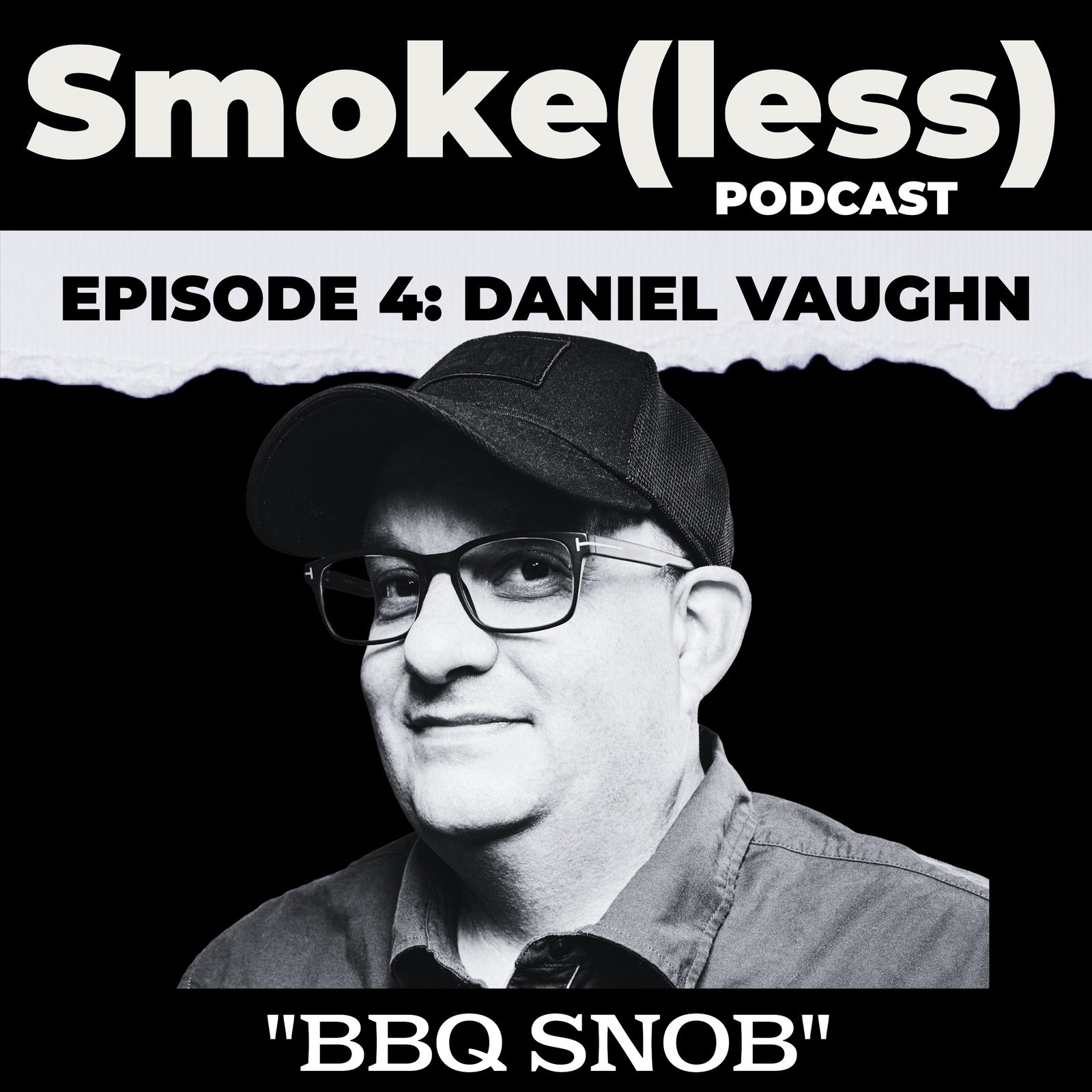
Daniel Vaughn is the most influential — and controversial — voice in barbecue.
As the BBQ Editor at Texas Monthly, he curates the legendary Top 50 BBQ Joints in Texas list: the ranking that pitmasters dream of, fight for, fear, and loathe. But his path to becoming America’s only full-time barbecue critic is anything but traditional.
In this episode of Smokeless, Daniel Vaughn reveals:
- How a simple blog changed his entire life
- The BBQ meal that hooked him instantly
- His unlikely journey from Ohio to Texas, from architecture to food criticism
- What people get wrong about the Texas Monthly Top 50
- How he handles pressure, backlash & pitmaster expectations
- Stories from the road, the pits, and behind the scenes of the list
If you’re into Texas BBQ, the restaurant world, or just love a good origin story, this is a must!
ABOUT THE GUEST
Daniel Vaughn is the BBQ Editor for Texas Monthly and author of The Prophets of Smoked Meat. He is considered the most influential barbecue critic in the world and has eaten at more BBQ joints than anyone alive. He curates the iconic Texas Monthly Top 50 BBQ Joints in Texas list.
Big thanks to Vic Barry for helping out!
Speaker 0
I'm accused of being a shadowy secret figure to being way too out there and having too many, conversations with barbecue travelers. Speaker 1
Does it survive you, or does it end with you? Is it, like, is there an expiration date? Yeah. Okay. Hey, everyone. Welcome to Smokeless. Today, we're sitting down with a man who doesn't just eat barbecue. He documents its story, critiques its craft, and in many ways, helps write the story, the history of Texas barbecue in real time. Daniel Vaughn isn't just Texas Monthly's barbecue editor. He's the only full time barbecue editor at a major publication anywhere in the entire universe. It says world, but I embellish that a little Speaker 2
because it's just fun. Speaker 1
Yeah. His words can make pit masters legends, spark heated debates, or challenge traditions that seemed untouchable. But beyond the brisket ratings in the top fifty list, who is Daniel Vaughn? What shapes his palate, his perspective, and his sense of responsibility in a culture where smoke and fire means so much more than food? Wayne wrote this, by the way. This is fantastic. Thank you, Wayne. Okay. Today, we're not just talking barbecue. We're talking about the man behind the pen, his blind spots, his surprises, and the legacy he hopes to leave when the smoke clears. Speaker 3
Welcome, Daniel. Welcome, my friend. Speaker 0
I haven't I haven't I haven't written a story with a pen for a really long time. Speaker 1
Yeah. He's just old. Oh, yeah. Speaker 3
You know? He had typewriter tablet, number two pencil. Speaker 0
My handwriting is terrible. So Speaker 3
You know, coming from an architect, his handwriting is terrible. Like, we're gonna believe this. Speaker 0
I I haven't lettered a drawing in a long time. Speaker 3
Yeah. But it doesn't leave you either. Speaker 0
I do write in all capital letters Yes. Of course. Of course. Anything. Speaker 3
Yeah. Just just habit. Right? Absolutely. Well, speaking of that, I mean, your architect background. So tell us. I'm sure there's gonna be people who have not heard of you before. I know it might seem weird on a smokeless podcast, but we hope that that's gonna be the case at some point. So why don't you give us a just a brief history of how the hell did you get here in front of us right now? What brought you into the world of barbecue? Speaker 0
Yeah. Well, I took the wrong exit off of thirty, but Speaker 1
I knew that was coming. Speaker 0
But I was gonna say Well, Speaker 3
go back even farther than that. Right? I mean, how do you go from Ohio? Speaker 0
I I am originally from Ohio. I I grew up in Ohio, was born in a in a small town in Northeast Ohio, Worcester, Ohio, and, spent my first eighteen years there. And then I moved to New Orleans, to be an architecture student, Tulane University. It's a five year degree. So after five years, I was looking for a job, and I found a good one in Dallas. And so I moved to Dallas, in two thousand and one, and I have lived there ever since. And one of the first meals I had after moving to Dallas was at Peggy Sue barbecue, and, not one of my first barbecue meals, but, like, one of my first meals after moving. And it, yeah, it just struck me as, like, how did how did a rib, like, get this texture and this flavor? Like, I only knew how to, like, overcook ribs in the oven and then finish them on a propane grill, with a lot of burnt barbecue sauce. And, then this brisket, like, was completely foreign to me. Like, I I'd eaten brisket, but only as, like, corned beef. And so I was just really interested in, like, how did this get on the plate? Like, how what sort of process went did this go through to get here? And I'd eaten a lot in Dallas and enjoyed the barbecue in Dallas, quite a bit. And, you know, going to the original Sonny Brian's back when they still, like, sold out around three o'clock in the afternoon, and and I just remember seeing these, it was really a blog. It was dallas food dot org, and it was a, really a message board. And he was talking about how terrible the barbecue in Dallas was really and compared to all of these great places like, Louie Miller Barbecue, in Taylor and, all these spots in Central Texas. I was like, really? How much better could it be? Like, smoked meat, like and so I scheduled a trip. My buddy Sam Watkins and I scheduled a trip down to Central Texas, using the two thousand three, top fifty barbecue issue, and it did, it did change our complete perspective on what barbecue could be, because everything that we'd eaten up to that point, we'd enjoyed. And all the stuff that we'd enjoyed, you know, after that trip, it was harder to come back and and really enjoy it after, after eating at Louie Miller. And that was really the first you know, I know you you've heard me say it before. You probably read it in the story about how much Louis Miller has changed so many people's lives and perspectives about barbecue, and and I have the similar story. And so I came back though and decided that, for d Magazine that I should pitch a story to them or an updated version of their best barbecue in the DFW area. And, or it was best barbecue in Dallas, and I was like, we really gotta expand this to the DFW area. We're gonna have, like, sixteen great places to actually call out here. And, I thought, I I remember thinking at the time, like, just nobody has done this to the depths that required to find that hidden jab in DFW. Like, if I go to every place that has barbecue on their menu, like, I will find it. I'm gonna find that, like, special place that that Louie Miller of North Texas, and it didn't exist. Speaker 3
So something about the cuisine that you experienced here really drove you to say, now my interest is not gonna be any other extracurricular stuff. It's really gonna be about this and what, finding and promoting of this or just personal satisfaction? Well well well Speaker 0
really, when I started, so I started a blog. It was actually a couple of years after that initial trip that I started the blog, Full Gospel Barbecue. But when I started it, it was really for me to keep track of for my own use, like and, you know, not be not have to repeat the places that I didn't enjoy and, be able to return to the ones that I really did like. Right? Like, that was the whole point of it. It was more personal than it was to be of use to an audience. Speaker 3
Were you more critical then? Speaker 0
I was yeah. Definitely. I was more Speaker 3
That's what I remember. Speaker 0
Well, I was much more critical when I started at Texas Monthly too. I went back and read some of those early reviews. I just wrote about Bill Dumas, the sausage sensei. And when I wrote about his barbecue the first time at Smokey Denmark, it's like, I was much more harsh. And, you know, I I apologize to him for that only for the fact that I'm really not that harsh anymore because we have so much so many good barbecue joints in Texas. It's pretty much all I write about are the good places that I go to. And so I don't write critically all that often. And, I mean, honestly, writing critically is a lot more fun. I mean, it just is. Yeah. Yeah. But our audience doesn't have the stomach for it. The number of complaints I get about people going to a barbecue joint that we recommended that they didn't enjoy, like, those are they they happen, certainly, but, they don't compare to when I write, like, something really negative about a place. Like the response that I get, like, how could you say that? Why you try to shut them down? No. It's just like it's, and I think that is a change in food criticism in general. Like, the food criticism isn't as critical, as it used to be. And I I think it's more, geared towards promoting, good restaurants than it is, critiquing restaurants that could be doing better. Speaker 1
And does that have anything do to do with knowing that the words could impact someone's livelihood, or is it just a I mean, because they have weight? A lot Speaker 0
of it really is, goes back to what I think my mantra is, like, for, for my job, which is to connect people with good barbecue. Speaker 0
That's Yeah. That's what I see as my main purpose in Mhmm. In the role that I have. Yeah. The the top fifty is certainly one of the ways in which we do that, but what I'm writing in those, you know, three and a half years in between is writing articles about barbecue joints that I go to that I like, that have something that they serve that I really enjoyed, that I think you should go try. Speaker 1
So, essentially, if it's if it's something that you don't like, instead of being critical, you just don't write about it at all. You just Correct. Yeah. Speaker 0
Yeah. I write about a third of the places that I visit, a quarter to a third of the places that I visit. Speaker 3
So is this an evolution from your your custom barbecue days of real just is this a realization or is this a feedback loop that has sort of helped guide your your your Speaker 0
It it's a little bit of feedback. It's a little bit of feedback. It's also that, you know, Texas Monthly would rather that I write, you know, just a couple of articles a week instead of, like, the five or six that I started doing. And so the the idea is really to spend more time getting the story of the people who are Speaker 0
Who are, you know, running this barbecue joint, than it is to just quickly get out reviews on food. Because, you know, as my as my writing, has become less critical, really, what is happening is I spend a lot more time writing about the people and their motivations and the circumstances that got them into barbecue, and I think that's as important as writing about the food. If you read my reviews from, you know, twelve years ago, it's really a lot about just the food and not a whole lot about the experience of, the restaurant or or the people behind that restaurant. Speaker 3
So when so you're you're writing this blog. You don't you're still an architect. Right? And you're discovering Texas barbecue as you're going through this process. Then how does that how does that spin itself into a barbecue editor position with Texas Monthly? Well, Pecan Lodge had a lot Speaker 0
to do with that. And there was It came up a lot. You know? Well, there was this there there was a list that came out shortly after I published a list, or d magazine published my list of the best barbecue in DFW. There was a list that came out from, a food writer in the the lead food critic of the Dallas Morning News about eight months after that. And, up to that point, she had shown very little interest in barbecue and shared really nothing of barbecue visits on social media. And so she came up with this new list of her favorite barbecue joints. It just happened to be that nine of her top ten were in my top ten except one, Pecan Lodge, which had opened after I published my list, and I had written glowingly about at the at the time. So, I called her out on it and was like, not even, like, a shout out for me doing all your research? Like, this is like, you've cribbed my list. And, to make a long story long, he, alright. So then Anthony Bourdain had had a particular beef with this food writer in the past for slamming one of his cookbooks when she was writing for the LA times and, or writing in LA. I'm not I don't remember which publication. And, so he saw this, like, kerfuffle in Dallas about a blogger versus an established food writer, and he, of course, just laughed at the idea that she was, looking bad in the situation. And so I was working on a book proposal at the time, and, my agent, David Hale Smith, had just moved to a different firm. He had been working as a book agent independently, and he moved to Inkwell Management, who was also representing Anthony Bourdain at the time. Anthony Bourdain had just announced that he wanted to publish a line of books, and David went to his, went to the people at Inkwell who he was still pretty new with and was like, I've got the perfect first book for Anthony Bourdain's line. And, they bought it, and it all worked out. And so I started doing research, out on the road all over Texas, for that book, and that got me rolled into Texas Monthly. They were using they were, you know, basically using a lot of my research to help them with their top fifty in twenty thirteen. And as we were moving up through, or as I was moving through the process of writing that book, I became less and less interested in architecture and more and more interested in the idea of being a food writer or making barbecue my life somehow. And I remember going to the Southern Foodways Alliance Symposium that was all about barbecue in Oxford, Mississippi in, November of twenty twelve, and I had the book deal at that time. I was in the midst of the research, and I started the weekend introducing myself as an architect, and nobody gave a shit. And by the end of the weekend, I'm like, I'm an author. Like, I'm I'm writing a barbecue book right now, and everybody was a lot more interested in me at that point. And so I called Jake Silverstein, who was the editor at Texas Monthly at the time, on the way back from that trip and said, I think we should do more with barbecue at Texas Monthly. I've been writing a couple of freelance articles here and there. I I was like, I think when this top fifty list comes out, like, we should just have that as a jumping off point of much much more coverage in barbecue on Texas Monthly, maybe, like, a full time position. And, I've got a good idea of who you should hire for that, and that was in October yeah. That was in October, October and November of twenty twelve. And by February of twenty thirteen, I had signed a contract and, started my job with Texas Monthly in April that year. It's phenomenal. It's I did
Speaker 3
The most yeah. It it's people take the most interesting journeys to get to their barbecue destinations, and that one ranks right there. Right. You know?
Speaker 0
But one of the things one of the lessons that I draw from that is I've told that story before, and I get it retold back to me. It's like, oh, it's about the passion and the drive. And I was like, no. It's luck and good timing. Yeah. Like, there's so much luck and good timing that made all that happen that there were other barbecue bloggers out there at the time. It just didn't work out the same for them. And, yeah, it's it's not about having the right amount of passion and, the right amount of drive. Like, that that certainly helps, but it really required a lot of luck and good timing to to make it to turn into the position of barbecue editor at Texas Monthly.
Speaker 3
Right. And Texas Monthly had just come off of that o eight list, which was a record setter for sales for them. Right? Number of issues actually sold that they would sat at the top for a long time.
Speaker 0
So Yeah. And it's always our best selling issue when it comes out. It's always the best selling issue of the year, but it's not always our most profitable issue Right. Because it does it does cost so much to put together as far as the the travel expenses and, all the expenses of the food itself.
Speaker 3
But you're right in the middle of the farm to table movement. Right? And you're also right in the heart of network television adopting food as as a curricular side and interest for Yeah. Tens of millions of people.
Speaker 0
Right? And a huge rise in interest in the idea of, like, artisan food. Sure. Yeah. And, I mean, if we're the the word certainly gets overused, but if you're talking about, like, an artisan food, like, a real craft, barbecue certainly fits that mold. Yeah. For sure. And and the equipment that you use to make it, you know, for the most part being, you know, very unmodern technology. It's primitive. It's Fire. It's smoke. It's it's meat. It's, made in a kitchen that if, if any other restaurant kitchen was at the same level of cleanliness as a pit room, we'd be like, what is happening here?
Speaker 3
Yeah. So from there then, you're now an integral part of creating this Mount Rushmore of barbecue gods. Do you realize that? I mean, you know that. Right? But you didn't know that at the time, I would think.
Speaker 0
Or did you No. I it it it wasn't I mean, I really just wanted to be on the team on the search team back in twenty thirteen. And when I took on the job, like, as as a full time position, I mean, my main goal was just like, oh, great. Like, now I got an expense account to drive all over the state and eat all these barbecue joints. Like, I have this giant map, a Google map that I used back then and I still use now. It's got green dots and red dots, and the red dots are the places I haven't been. And I still like, I gotta get to these red dots. I gotta turn them green. Like Mhmm. I gotta get to all these spots and try them all, because that's the only way you can find the hidden gems is to
Speaker 2
you gotta go to them all.
Speaker 0
Yeah. It's it's a lot harder these days to find one that, like, nobody has already written about or covered or, it you know?
Speaker 1
And you're you're expanding beyond Texas now too. I mean, it's you're exploring barbecue sauce.
Speaker 0
Expanded, beyond Texas. Let's not use it in the present tense because I don't know if I can do that United States Texas barbecue list again. I did that. It covered, thirty some states and and tried all the Texas style barbecue outside of Texas as I could, but that was, that was a huge undertaking. I was yeah. I was I was getting a little bored, and I knew I had some time before we had to kick off the search for the the top fifty list for twenty twenty five. I convinced my editor that it was a good good idea to pay me to fly all over the country and eat all this barbecue, and, it was fun. It was really rewarding to to try all this stuff and see how Texas barbecue yeah. See how Texas barbecue is spread. And, yeah, there are some really fantastic barbecue joints out there. And so two things about that, and I've kinda briefly talked to
Speaker 1
you about this before about the article of United States of Texas Barbecue. You know, I feel like some of the joints out there, you know, they're, like, they're saying, well, we're the best in America or, you know, we're we're which is I don't think that was really your intention. But would you say that of of the joints you tried that are not in Texas, that some of them could definitely, if they were in Texas, be contenders for the list? Because I've had
Speaker 0
some Absolutely.
Speaker 1
Yeah. I've had some great stuff out there. But I don't think that they get to say regardless that they're the best in America. That really wasn't the intent of that. It was just highlighting ones that are great outside of our state, who doing our style of barbecue, which to be honest, Texas barbecue, I think, is that is the style of barbecue that I think everyone's thinking about now when you say barbecue today. It's Texas style barbecue. You go to to any joint up and down the East Coast, and that's what they're all trying to do. They're trying to they're trying they're cooking brisket, and they're
Speaker 3
doing all all the stuff. Tell them to stop. Yeah. I mean, they're squeezing our supply.
Speaker 0
Finding a new barbecue joint a new barbecue joint anywhere that's not serving brisket is a challenge.
Speaker 3
Killing us, dude. And we're we're we're still in the two of our own success. Right?
Speaker 0
Yeah. There's still only two per animal.
Speaker 3
Well, Jesus Christ, man. This is it's ridiculous.
Speaker 0
Where Texas barbecue needs to just evolve. Okay. This is yeah.
Speaker 3
This is go ahead. Tell us about it.
Speaker 0
Well, I mean, look at a place like Leroy and Lewis. Right? I'm I'm not saying that every place needs to needs to copy the way that they put their restaurant together. They have a a a menu that goes way outside of, traditional barbecue. But one of the things that they're doing that is as old school as you can get is using all these different beef cuts and and buying them locally. Yeah. They actually have a local Texas rancher, and they're using his beef. They use some other beef as well, but, using their beef and the same for their hogs too. So, all those are Texas raised. And so that what that does is it forces them to use a good bit of the of that beef carcass and the whole hog. Yeah. And, you know, that's, I think if as long as Texas barbecue remains completely dependent on just brisket as the beef cut, you know, I I think it's just not gonna go well. I think it's just the the it's not gonna get any less expensive. The name brisket has value to it, when it's even put into, like, a burger. Oh, this is a hundred percent ground brisket burger. Like, brisket itself has panache that it did not have before, that word. And so I think until I think Texas barbecue needs to really go back to its roots a bit and look at other cuts, that that we can cook. Other beef cuts that we can cook and, so that we're not just dependent on that. And I and I know that beef has gone up in price across the board, but at least if you're cooking different cuts, you know, you can do a little less of the expensive one this week and a little more of the one that's a little less expensive. So but then I also don't run a restaurant. And I know that when I talk to barbecue joints all over Texas that, the first the most popular thing that is ordered at all of their restaurants is brisket. Yeah. So it's gonna make a lot of people unhappy if the brisket isn't available, but, for sure, if you can, but, I go back to this passion thing I I hear from new barbecue joint owners or or those who are doing you know, getting into the business in, like, a pop up fashion or or do still doing part time. I don't care about making money. I just I'm doing this because I love it. It's the passion. It's like, well, if you don't make money at it, you're not gonna be able to do the thing you love very long. Like, you have to make money. That's gotta be one of your guiding principles. Is is this going to be profitable? And if it's not, then you're not gonna be able to do it for very Speaker 3
long. Yeah. Well, I mean, that's the downfall for, I think, entry level for most small independent restaurants. I can cook well or my wife can cook well. Somebody in the family does that well, but nobody has any restaurant operational or management experience, much less finance experience. How do we keep this thing afloat during downturns? Speaker 3
And I think that's I think we're looking at one of those pivot points, those these inflection points in that in our sort of history timeline of we've seen this increase in the number of places over time for the last twenty years. I think that we'll have to start seeing a retraction at some point because I I just don't know how many people are gonna look at this and when they're so heavily dependent on just brisket itself, if they don't have a base already, the price point just may make it impossible for them to stay afloat. That and and labor, so your prime cost are just blown out of the water. If and so if we don't if we don't start taking maybe some cues from our southern brethren, start looking at some more white meat options where we actually have some margins to play with, then I think you're gonna see even more people start to bail on this until such point that we see pricing come back down because the demand has come back down. Speaker 1
I mean, we've had to bail on you know, Prime was really accessible for a while, and everyone jumped to Prime. Well, not everyone, but a lot of people did. And this is not tenable right now. I mean, at least not for us at the volume that we're having to buy. And so, you know, we're having to just work our way around, you know, making money because we are we are a business with, you know, still obviously striving to to cook great barbecue. But, you know, the choice the choices you have to make do that, that's that's the one I think a lot of people are having to make right now Mhmm. Is is getting away from prime. And I don't know if that if the prime market's gonna implode and, you know, hopefully, we'll have access to it again. That's, you know, not insane. Speaker 0
Well, Ronnie Killen just told me that he is gonna go all to, Snake River Farms Wagyu Briskets, for the simple fact that, they're they are more expensive than prime, but the difference in price that he's paying the difference in price for them as raw, per pound right now is, like, minuscule compared to what it was five years ago. And so it just hasn't risen very much Mhmm. Because there's not that huge increase in demand Yeah. For the Wagyu brisket specifically. And so he's like, well, I have to charge a lot for them, but at least, like, it'll stay there. But y'all are in a bad position of you gotta be hating seeing these new spots pop up, and they can put whatever price on the board they want. Yeah. And they don't get as many complaints because you they don't have established customers like y'all. They're like, why are you raising your price? Speaker 1
Mhmm. And they're also cooking six or eight sometimes versus forty, fifty, eighty, hundred and twenty. You know? Like, that but that both Speaker 2
of those points, true for sure. And, Daniel, you you talked about the need for Texas barbecue to evolve, and I think that's true. I'm curious, how has your definition of Texas barbecue evolved over time from when you started early on to now? Speaker 0
Well, before I was writing for Texas Monthly and writing the blog, I I thought, like, okay, Texas barbecue is low and slow and, you know, just, it's it's all about brisket. It's all about low and slow and spare ribs and simple seasonings. And if it's not that, then it's not really, like, true Texas barbecue. And now I use that sort of as a punchline for people who argue the same things. Like, well so you're saying, like, Crate's Market is not Texas barbecue or Smitty's or a place like Cooper's who's cooking directly over the heat. So, you know, my I guess my definition of Texas barbecue is really widened to barbecue that's cooked in Texas. Mhmm. I if it's a whole hog and you're cooking it in Texas, it's Texas barbecue. I mean, it's barbecue that's being cooked in Texas. Like, why why do we have to worry if it's, what the what the protein is? So, yeah, I would say it's widened quite a bit. I would say I certainly love seeing some of the, like, immigrant cuisines coming in, and, you know, I just went today. I ate at a place called Habibi Barbecue, and it is Lebanese barbecue, and, it's run by this this kid, Mark, Faisal. And he's a this he's this great kid. He's, like, nineteen years old. He's in college. And on Friday nights, he serves a partial barbecue menu, and on Saturdays, serves a full barbecue menu from his food truck in Arlington. And, he's just bought a big new smoker, and I ate there, a year ago, just right after he opened up, and he just asked about he asked for advice. He wanted some, like, serious feedback, and so, I could tell that he really wanted to improve. And so I just laid it laid it out there for him, like and I said and I don't want you to take this too harshly, but you're gonna look back at this food that you serve you're serving right now, and you're gonna look at photos of it, and you're gonna be embarrassed a year from now. If you keep at this and you keep doing this and and you keep cooking into a fresh batch every week, like, you're gonna look back a year and you're gonna be like, what was I serving? And I said, you know, you you take you're gonna take that really harshly right now. And I just saw him today, and he's like, I remember what you said, and you are so right. Like, I look back at those trays of barbecue that I was serving a year ago. Like, what was I thinking? And the barbecue is so much better. And, so when I first wrote about it, it was because he was on the show called Barbecue High. And, you know, this at the time, eighteen year old kid who was doing this weekend only barbecue truck, but now I'm gonna write about it as like, alright. This is like a serious barbecue operation going on. He's really improved and is really making great barbecue and is, doing it, like and he's he's really, taken hold of the Lebanese side of his heritage in a lot of the cooking. Like, he's got a tabouli salad on the menu. He's got this, Lebanese style slaw that he's, serving and also putting on top of his smash burgers. He's got pita bread, underneath all the barbecue, so all the nice fat drips down onto the pita bread and, serving it with, like, a yogurt sauce and then a garlic sauce. Anyway, so places like that, you know, Smoke and Ash, also here in Arlington, doing Ethiopian barbecue, Egyptian barbecue, KG barbecue, you know, seeing seeing that change the sort of flavor dynamic and the, and, you know, the seasonings into the meat, the way sometimes the meat is presented in, like, rice bowls and things like that, I think that sort of transformation is is just a positive for Texas barbecue. But I also think that it is, it's a statement on how you have to differentiate yourself in business if you wanna draw in that that finite group of customers to your barbecue joint. Like, what can you do differently instead of just going out and replicating a Louis Miller beef rib or, you know, doing your own version of a of a stuffed baked sweet potato? Mhmm. You know, instead of just doing that, like, what can you bring what can you bring of your own voice into the food that you're serving? And I think that does resonate with people, but I also think it's a way, the the restaurant tours, they have to use that to, to really just, like I said, draw on that that finite group of customers. Speaker 2
So as you're looking at all these different places that have opened and each one has its its different perspective, how what's the common theme that you judge them by if somebody somebody has tabouli salad and somebody doesn't have tabouli salad, you know, what what's the what's the criteria? Speaker 0
Yeah. You know, just because you have mac and cheese, doesn't make it, like, more authentic. Right? It can still be terrible mac and cheese. Mhmm. You could also serve a terrible tabbouleh salad. Speaker 0
And so, for me, when I'm, when I'm judging, you know, one barbecue joint next next to another, it's really about the meat Mhmm. Is is really what it comes down to the and and also trying to gain an understanding of what is their what is their target. And whether or not I really like a sausage made this way or really like, let me say that again. Whether I really like a certain side item or what that's presented to me is, like, are they making it properly? Are they Mhmm. Are they going through the right steps to make it? But, you know, the other thing is I I get asked questions like that a lot because of the top fifty, and it's like, that's really the only time that I'm, like, judging one place next to the other. Mhmm. Speaker 0
for the most part, I'm really just writing about a barbecue joint's food and how they came up with these different menu items and and how, you know, how people are reacting to it and how I enjoyed it, on its own terms, not really in comparison. Speaker 3
So it sounds like this evolution that you're you're speaking of is more conducive in an urban environment than it would be in in a rural environment. And a lot of that will have to do with palate, a lot of will will have to do with, disposable income population density who can support more, I would say, fringe flavors, something they're not accustomed to. Speaker 3
So do you do you see that there's a split in in the barbecue industry in Texas anyway, where you have a further let's call it more urbanized, chef y environment development in one, in one branch and more of a we're holding true to just what we've done for god knows how long or what or what the simplification of the pilot is. Everybody's got salt and pepper on their table at home, so that's just what we're gonna use Speaker 3
And and stay the course in the smaller communities. How do you how you know, if there Yeah. Speaker 0
It is definitely much of, it definitely is a big rural urban divide that you're talking about. Like Yeah. There aren't a lot of rural barbecue joints that you're gonna go to and find tabbouleh salad or, La Oca Barbecue in Port La Oca is really one of the outliers. They're in our top fifty list or in our top ten, and the what they've been able to do in that little town just south of Victoria is they have turned themselves into a barbecue destination with this, like, big city style of barbecue, but they also have, like, a a second menu, which is, like, here's our value menu, essentially. Like, here's our meatloaf sandwich. Here's our chicken quarter special. Like, here's everything. Like, if you wanna be a, you know, multi times a week customer at our restaurant, we have the value built into our menu and these certain things, but we also have the showstoppers. Now that's that's a lot to ask of Speaker 3
a restaurant. It totally is. Speaker 0
And, you know, you know but I look at a place like Louie Miller, and it's almost like you're you're hampered by or you could be. I don't know if you say it in a lot of ways. You're you're hampered by the tradition. Like, people expect the specific thing out of what you're serving. And if they show up and you're not serving that, it's like, why did I come here? Yeah. And I think newer barbecue joints have that freedom to to be whatever they wanna be. Whereas, like, if you they come to Louie Miller and you don't have a big old beef plate short rib, like Yeah. What's happening? Speaker 3
Tiki torches and pitchforks come out. Yeah. You know? Speaker 0
But, I mean, that beef rib specifically, like, I was I did a story on Tyler's barbecue who who will be your servant tonight at this event. And Amarillo? Amarillo. Yeah. So Tyler's Barbecue, I went in there a couple of months ago, and I got a beef rib, and it was sixteen dollars a pound. And I saw it on the menu, and I was like, what? Is that half pound? Like, what what sixteen dollars a pound. And get up to the counter. Like, I'm thinking I stole this thing. Right? And I called him later. I was like, this is, like, this is on purpose. Right? On Saturdays only, they serve this sixteen dollars a pound. He's like, yeah. You know, I could charge what I need to to make money. And if I did that, then people would just be talking about the fact that they came here and ate a fifty dollar beef fruit. But now they talk about they came in here and ate incredible beef fruit. And he's like, I don't make any money on it, but I only serve, like, four or five racks, like, four or five racks on a Saturday. He's like, I wasn't gonna really make a whole lot of money on that anyway. And so, yeah, it's just this, like, little SendGrid. Speaker 3
Media loss leader for him. It's Right. It's his. Speaker 0
And so I went to mill so I was curious. I'm like, alright. What's when's the last time a Louie Miller barbecue beef rib was sixteen dollars a pound? And do you know? It had to be Speaker 3
I was probably there still. It had to be early teens, early two thousand ten, eleven? Speaker 0
It was twenty fourteen. Twenty fourteen. So I I went back and I just looked at old photos of the menus on Google, and I found one from somebody who came to visit your place in, like, January of twenty fourteen, and they took a photo of the menu. Yeah. And it was fifteen ninety nine a pound for the beef ribs. Speaker 0
And but that is how much how quickly things changed in Texas barbecue because I I can't imagine that your beef rib price doubled from two thousand to twenty fourteen. Speaker 0
Okay. So it was, like, eight dollars a pound maybe in two thousand? Speaker 3
Oh, no. No. No. No. No. I mean, well, no, because we were using chuck rib Speaker 0
at the time. Oh, that's right. Speaker 3
And so it was a dollar less a pound. You know? I mean, it's, you know, thirty percent less than the plate. So, yeah, it was and he didn't you know, he was probably selling five racks maybe. Speaker 3
it was it was cheap. It was pretty cheap. Yeah. It would it would have been right there with brisket, I think, when he was, you know, eight bucks a pound for brisket. Speaker 0
So the I I guess that was surprising to me that it was, like, twenty fourteen, that it was sixteen dollars a pound. I don't know. I I guess I'm getting older because that doesn't feel like that long ago. Speaker 1
I was just gonna say it doesn't seem that long ago. Speaker 0
It's but it is eleven years ago. Speaker 3
mean, but the last five years have just has been everybody's timeline is just screwed. Right? Nobody feels the cyclical nature of of what they re of what they remember from years past from COVID on. Things have just not been the same. Speaker 0
Well, I remember as a kid hearing about the idea of inflation, and it never made any sense to me. It's like, why do the prices just keep going up? And, like and, also, like, these jumps like, these differences that we see, there had to be some, like, real jumps. Like, this couldn't all just be gradual. Right? And then Right. And then twenty twenty happens, and you see how it's just so nongradual. Like, those inflection points that you talked about have really shifted the the value, the cost of everything, And, that certainly has to be borne out by the by the customer at Speaker 3
the end of the day. It happened though during the remember the droughts of eleven, like, through fourteen? We saw brisket go up into the fours that we were just all I was horrified because it's like Speaker 1
I was, you know, not that Speaker 3
long ago paying a dollar twenty nine a pound. What am I doing paying three times as much for this? And it hung there. And, of course, it came back down, but it always settles above where it was prior to the prior to it taking off. Right? And I think we're in another one Speaker 0
of those There's no more settling. Speaker 3
No. It'll drop back a little bit, but, you know, ultimately, we're you know, you're not gonna see it below four and a half, five bucks a pound on prime, probably. Speaker 1
But it is it is it tenable? And we talked about this a lot. At what point is it gonna be that people are just like, yeah. I'm out not doing it. Well, yeah. Speaker 0
I mean, places the the places that'll have to close is, I think, not because I think the the places that'll have to close are gonna have to because the prices have to go up if they're gonna be remain profitable, and that is just gonna mean a smaller customer base to to draw from. And there's just not gonna be enough barbecue customers that can afford it to support all the barbecue joints out there. I mean, I wrote back in twenty twenty three, I think, that, like, we have too many barbecue joints in Texas. Like, and it's I I felt like then we were about to hit, like, a tipping point where places were just gonna have to start closing because there's just there's too many options. Mhmm. There's just so I'm I'm writing right now. I'm updating all the barbecue guides, all the local barbecue guides, like, for Dallas, for, different cities around the state. And it's just like, there are so many places. Like, in if you look at Houston and, like, around Houston, places that I'm recommending it, it's like I got, like, thirty five or forty places to that I can solidly recommend. Like, you're gonna go get some good food at this barbecue joint. Yeah. That is a ton of of options Speaker 3
in the last ten years has really, like, upped their game from next to nothing to suddenly making a huge imprint on the state. You know? And I think that's just the community there. Mhmm. They they seem to very much be intertwined with each other. Speaker 0
Well, and, you know, and that's that's just the difference in in cities, all across the state, really. I mean, a lot of that started with Pecan Lodge, with Lockhart Smokehouse coming into Dallas, and then you had Franklin Barbecue in Austin. And I just think for a long time, these these, cities just weren't seen as barbecue destinations. All the, like, barbecue destinations were rural. Yes. They were out in Taylor, Texas, or they were out in Atlanta or or Lockhart or, you know, eventually, Lexington. We think of Snow's as, like, this old barbecue joint, opened in two thousand three. Yep. So I guess it is still I guess it is kinda old at this point, but, it's almost a classic. Couple more years. It's definitely a classic. If you got if you got Tootsie on staff, it's Speaker 0
She could open a barbecue joint tomorrow, and it would be a classic. But, yeah, there there is that that big difference of, you know, the cities being real barbecue destinations, and that has really that started about the time that I was becoming the barbecue editor and has just really accelerated since then. Speaker 3
Yeah. I mean yes. And, I mean, but barbecue abandoned the cities a long time ago. They've been in the downtowns a long time ago. It just got too cost prohibitive, I think, and it wasn't the type of cuisine most cities were looking to, you know, bring in business clientele. This it just didn't match the demographic. Speaker 0
Because the the barbecue that was served in cities was there was a barbecue shack. It was a sandwich shack. Right. Speaker 0
It wasn't some place that you're gonna go spend a hundred and fifty dollars on lunch for four Speaker 1
spread and drive like, hey. We're gonna go out into some crazy part of town or out in the middle of nowhere to go Mhmm. Speaker 3
Go to this spot. Well, but that's what developed. Right? As as you saw a decrease in the in the urban centers, you saw the the fire still alive in these satellite small towns in and around. Nothing lasted in interior, but a lot of the old places, they owned their building. They owned the land around them, so they didn't have a a lot of large overhead. They themselves work maybe a couple of family members. I mean, they could run it. Their prime cost were just incredibly low. Mhmm. Right? And so they could pull it off. And it's the places that I think survived because of it, especially, like, coming out of the seventies. Seventies were horrible for downtowns of of any kind. It just decimated them. Right? And, you know, so the ones in in the small towns are the ones that survived, because they could. And their their tax base wasn't pushing them out the door either, you know Right. That they have no control over. But, Speaker 2
but I I do but I Speaker 0
do miss the rush of the find out out in the middle of nowhere Yeah. Finding that barbecue joint that, like Right. You hadn't heard about before and, you know, you could show off to your friends and things like that. I, I came into Stanley's, not long ago, and before I did, I was at Bodacious Barbecue. And the guy I was standing out in front of the bill the building with, before they opened the doors, we were talking about barbecue a little bit, and he fancied himself. Not a barbecue expert, but he'd been to a lot of places in East Texas. I was like, oh, man. So you've been to Pat G's. Right? He's like, no. What are you talking about? I was like, you live in Tyler, and you've never been to Pat G's? Nope. Never heard of it. I was like, I got a place. You gotta you gotta see photos of this place. You gotta get there. I think you gotta go check it out. Speaker 1
It's one of those two. Yeah. It's Speaker 0
Have you been there, Justin? Speaker 2
I've never been. I've seen pictures. Speaker 0
Well, you just made it to Stanley's for the first time. I did. Speaker 2
I did. Okay. You did. It was amazing. Speaker 0
So you gotta get but but you gotta have another trip back to Speaker 2
But having not been to Pat G, seeing the pictures of it, that's like the the dream barbecue place to discover. Speaker 2
The little place in the middle of nowhere run by an individual. Yeah. You know, it's it's like the it's like the perfect. It's the unicorn Speaker 0
kind of. Except on the flip side of that is it is that, like, mythical spot. It is almost like a it's that story that's been retold over and over. Right? It is the picture of that. But the barbecue, you know, it's not the best barbecue you're gonna eat. Like, it's just it Right. It's it's satisfying. It's it's a good good place to go in and get a sandwich, but, like, you go just as much for the experience in the place as you do the barbecue. So it sort of proves the point of, you know, all the best barbecue doesn't come from dilapidated shacks out in the middle of nowhere. Speaker 1
It's it's never never been the trip's never been about the barbecue. It's always just been about the trip. It's the two lane roads through the pine trees and, you know, the experience of when you get there. And and it's pretty incredible. It's Speaker 0
I mean, the best best way to explain it if you have never been there is that when it burnt down, they were open five days later. Speaker 1
Yeah. That is that is the best way to describe it. It's, it's just you walk in, man, and, like, Speaker 1
one of the last times I actually went with with you, and you it was in the wintertime, and they they they heat the dining room with a, it's like a fifty gallon drum that's like a a wood Speaker 0
Now come on. It's a proper, like, little potbelly stove there. Is it now? They have a stove. Speaker 2
And that's just, like, burned down? Speaker 0
I know. Can you believe it? It's all wood construction. Speaker 1
The smoke just, like, literally cut the room in half like the sunbeam. Yeah. You feel like you're stepping under the smoke when you come in. Speaker 3
And, I mean, it's Speaker 0
You cannot go back to work after a meal at Pat G's and and people not know that you went and ate barbecue. Like Yeah. You are you are coated in smoke. When you get when you order an iced tea, they're like, well, get over there in the, in the refrigerator the residential refrigerator, open up the freezer, and there's cups of ice in there. So grab yourself one and then fill it up with iced tea. And if you want the potato salad, they go get a tub, like a Tupperware, out of the fridge Yep. Scoop it out for you. When they when you ask for sauce, it's a like, some old mayonnaise jar or some sort that just has barbecue sauce in it, no lid, and they just pour it on, straight out of that jar. It is it is an absolute throwback of a place. And I I send people there, like I said, not so much because you're gonna go get the best barbecue sandwich you ever had, but you're gonna go to a museum. Like, you're gonna if if barbecue has a colonial Williamsburg, it is Pat G's barbecue in Heiler, Texas. Speaker 2
Well, you gotta, in a way, worry about places like that going away and that that kind of extinction of that part of barbecue. You know? I mean, that's a very unique experience that is very hard to find now. I mean, I don't know if there's a handful of places maybe where you can go to go and have that experience now. Speaker 0
Yeah. I mean, so many of our storied barbecue joints are you know, they're not, like, humble buildings. I mean, Louie Miller might be it might be an old building, but that place is, like, far from humble. Right? It's like a cathedral you walk into the place. Kreitz Market, the the new one that they built in ninety nine is massive. I mean, Smitty's certainly still has that quality to it. Like Mhmm. Yeah. This is, this is a special place. Like, this this building is special. But you're right. Like, you know, the the new barbecue joints, I mean, they're never gonna get that same patina. Mhmm. And, you know, for the most part, the health departments aren't gonna let them operate in in the way that's gonna allow them to get that patina too. No way. Yeah. Speaker 1
No. I mean, that was a huge part of when I took Stanley's over. You know, when you change ownership with an old place, like, all the grandfathered stuff is out the window. Mhmm. Speaker 0
Yes. But you have maintained the character through all of the upgrades that you've done and the expansions and, you know, taking over the building next door, when you walk in the front door at Stanley's to go order barbecue, you still feel like this place has been around
Speaker 0
Like, I can tell because, like, the the flow is all wrong. Like, they're they're standing in line versus people trying to get drinks, some people going to the bathroom. Like, yeah. This is, like, you're working with what you had You super with
Speaker 0
got, and and you're making it work.
Speaker 1
Yep. Well, trying to. And it's it's been fun. It's been amazing. So never trying to, like like, be bigger. We can't really be bigger. We're just trying to be a better version of ourself and and work through those things that make make it complicated and weird sometimes. But inevitably, we all are accustomed to seeing someone having no idea where to where to go. And, that's a cool part of our job is just like, hey. You ever been here before? And then you get to meet somebody and be like, hey. Let me show you. Come this way. And that's a huge part of of what I love about it. Well,
Speaker 0
I I I will give you a tip, though. It's a lot further drive from Dallas than than going out to Tyler. But if you have never been to Kolodchny Barbecue in Hallettesville, Texas, I'm not joking that I I talked to somebody, a few months ago who grew up in Hallettesville and lived there in the nineties, and they had not heard of the place. And Hallettesville is not big. No. And Kalash and Barbecue has been open since nineteen eighty nine. And they're, like, in a residential area of Hallettesville. I mean, the, like, the downtown, the bank is north of the highway, and they're they're south of the highway. And it is, run by an older couple who has had it since nineteen eighty nine. It's only open on Saturdays and Sundays, and they open up at ten o'clock in the morning. And if you get there eleven, it's dicey, like, because there are a lot of people who call in their their orders ahead of time. And so if you don't call in, you just call in your order. It's it's gonna help you out. You go back in the pit room and you order, Irvin Kolochny will will slice it off. And he stopped, wrapping it in butcher paper, and he's got rotisserie chicken bags for everything. So, like, it's a little zip top bag. Right? It's a rotisserie chicken bag, and he puts all the barbecue in there, and it he can pile it all in because it's all the same price per pound. And when I realized, like, how special this place was was the first time I went in, and I could only get, like, sausage and chicken because I hadn't called in early, was that all of the customers, not all of them, but many of the customers came in with their barbecue pail. And that pail was, you know, metal pot or whatever, and it had the tare weight of the pail on in masking tape
Speaker 0
side of it. Uh-huh. And so, you know, she'd take it, put it up on the scale, and minus the tare weight that's on that masking tape from that barbecue pail, and that was how much she charged them for their barbecue. And that is a place that is, you know, tied to a community. Right?
Speaker 0
Yeah. And, we put them on the list for the best new barbecue joint list in twenty fifteen, I believe. And, the next time I went, I called in, and I I said new because no one had ever written about this place. This is twenty fifteen. It's been open since nineteen eighty nine, and it had zero footprint online. Like, nothing on Yelp, Facebook, Google, like, nothing. And, so I I I wrote about it, included it on the list, and certainly patted myself on the back of letting people know where this, this barbecue joint that, you know, this unicorn of a barbecue joint was. And, the next time I called in my order, I was like, okay. Well, what's your name, Daniel? What's your last name, Vaughn? Are you from that magazine? I was like, yeah. Texas Monthly. I just wanna tell you that if you're coming in here to put us on another list, don't. You can I'll I'll make your barbecue for you, just please don't put us on another list. Like, we don't we don't have the energy. Like, the yeah. We we wanna serve our our small town. And when I when I came in to get the order, I told her I couldn't promise anything, but, she's like, you know, maybe I was a little harsher on the phone than than, than I wanted to come off. But, really, we would rather not have that sort of publicity. It's just we can only cook so much food here, and we got we got regular customers to serve. And so That's Speaker 3
a true unicorn right there. Speaker 0
Yeah. Yes. Exactly. Speaker 3
And, who has their understanding in their place and their base totally square in mind? Speaker 0
So it's a colosseting barbecue. I'm sorry. But for the millions of listeners of the smokeless podcast, now Yeah. Going to the set That's out of the bag. In Palletsville, Texas on Saturday and Sunday mornings. I'm sorry, but it it'll, yeah, just get the pork steak. Speaker 2
Both of our listeners are gonna be down there next week. Speaker 0
And then Yeah. House made sausage. Speaker 3
But okay. So here's a a place that's truly guarded about its culture that it created with its town. Are you seeing the culture of barbecue change just in general from when you first made your splash to now? I mean, ten years, twelve years. That's, I mean, that's a lot there's a lot of time. We don't think of a decade really as being that long, but there's a ton of shit that's happened. Go back to let's make the divide between twenty first and twentieth century. It seems to me that barbecue has sort of evolved out of a culture and moving more into a concept away from cultural its cultural roots and background, just as you were saying earlier, cooking multiple different cuts, using everything locally sourced. That's how peasant food is developed. Right? This is this is where we got a meat market. We got stuff coming out of the cabinet. This is what's gonna go bad in two days. We're cooking that. We got a steak special this today or tomorrow, and you don't see any of that anymore. Speaker 0
Yeah. I mean, Prowsy Meat Market was really the last one around. It was a true meat market. You know, it's still operating as a true raw meat market that had barbecue in the back as a side business. Yeah. And, you know, that closed in twenty twenty or twenty one. And when it closed, I was pretty much the only one left that was still like that. So, yeah, as far as, like, those roots of Texas barbecue, like, that that culture, it's gone. Yeah. Like, if there's a raw meat counter somewhere, it's for show. Yeah. I mean, it's it's like, no. Here's a symbol of of our barbecue past. And so that, you know, that I think is is gone for good, just because people go to the grocery store to buy all their food. Like, they don't they just yeah. Yeah. People go to the grocery the the grocery store killed the meat market barbecue joint. Right? Like, the HEB meat counter. Speaker 3
Stores and convenience and pricing. Speaker 0
Yeah. But, yeah, I I I said it's a different culture, right, Speaker 3
that you see saying that One Speaker 0
of the things I was with Roy Lewis. Well, one of the things I was talking about, though, is, talking about talking to people about their motivations. And I certainly have seen a lot more here recently. Like, the motivation for opening up a barbecue joint is to make it on the top fifty barbecue. Speaker 3
just Right. And we we briefly touched on that Yeah. When you guys were in Taylor. Speaker 0
And it's, if if, like, validation from my opinion is the reason that you're getting into this, it's just not gonna be it's not gonna be very rewarding. Right? Like, you you've gotta if you're gonna open up any sort of restaurant, you need to do it so that you can, like, please your community, you know, so that you can serve them something that they need. You can fill a hole that they, that they have in their, you know, in their cuisine or in their food community. And if your if that's not your motivation, then, yeah, that's gonna be a tough one unless you get, you know, unless you do get the the accolade that you think is going to complete your life. Speaker 3
It never does. No. Because now you're chasing the next one. Right. Or a different ranking. Well, and the and the moving up. Speaker 0
The folks that got the Michelin star. You know? I was at the event that night and, you know, saw the the beaming smiles of folks from Leroy and Lewis and Interstellar, Love Barbecue and Corkscrew, and it was great moment for Texas barbecue that they all got the star. And, I was getting a drink at the bar with Evan Leroy. I was just like, well, you know, don't have too many of these. They could be at your restaurant tomorrow. Speaker 3
Yes. Like, for next year. Speaker 0
Like, it is a constant thing with Michelin. At least with the top fifty, you know, it is, like, a finite it's about a six month period where we go out and prepare for the next list. Speaker 3
Preparing for the list. How do you do that? So what is the criteria? Like, back in the day when you had, you know, when Pat and, you know, Joe Nick and Paul Berca. Paul Berca. Yep. And Jim Shaheen. I mean, they were putting this list together. It was a bunch of good old boys, right, just who happened to be traveling around doing stories, eating barbecue while they were on the road, and they're like, this is what the places we like. You know? That criteria, whatever that was then, is I I think that is a long memory away from what criteria might be today. Speaker 0
Oh, yeah. If you were if you were on that team and driving around and you found a new spot that had some decent barbecue, you're like, yeah. Top fifty basically right there. Like, no question. And, you know, you, you you look back at our even our list from two thousand three or two thousand eight and a lot of the places that are that were on there is, like, the ones that are still open, most of them just wouldn't even be considered. I go back and look at photos from, I go back and look at photos even from Louis Miller and look back at what you all were serving and the way that food looked back in, you know, twenty twelve or whatever compared to what it looks like now. Yeah. And it does not it's it's hardly recognizable minus the beef root. Yeah. And so, the the criteria has certainly the criteria is the same, as the first list I worked on in twenty thirteen. It's just that the places that meet that criteria have just exploded. Speaker 3
So what is the criteria? Speaker 0
Well, we have a big score sheet. So, actually, it goes back to, like, my whole job as a scouting mission for this top fifty, essentially. Right? Like, I'm out there trying all the new barbecue joints that I can and and writing about them. And then, so when we we put together first, like, this master Excel spreadsheet of, of all the places that we need to visit, to come up with the top fifty. And so that is a it's a pretty wide list. I think this last time, I think we had about three hundred and fifty spots on it, and I think we ended up going to, like, three hundred and twenty five of them. Anyway, there were some of them that just were either closed or, maybe decided to to take weekends off a little too often. Like, there's a reliability factor too. Like, if we're gonna put you in the top fifty and, like, you just decide to close-up every other weekend because, like, your dog is sick, then, you know, it it changes some things. But, anyway Okay. Back to that big list. Yeah. So then we, we gather a team of people who are willing from the Texas monthly staff to be on that team. And Which is how many now? I think it was twenty five this last time. Okay. Twenty five. And there were some freelancers in there too. And so, people whose opinion of barbecue we really respect. And so we, we basically split up the whole state in different regions, and we assign a region to each one of those people. So this time around, I think everybody had somewhere, like, thirteen to fifteen different barbecue joints they needed to visit over a three to four month period, and then they and we have a very specific score sheet to fill out that is, on a five point scale, the brisket, the ribs, the, sausage, the poultry, and then we encourage as many detailed notes about sides and desserts and sauces and whatever, atmosphere, just funny stories, anything, that might make it into that really, like, short entry in the print issue, which is only about a hundred and hundred and ten, hundred and fifty words. So, then I gather all those score sheets up, and and in turn puts them all into an Excel spreadsheet with all the scores, and then I pour over all those to determine, all the spots that I need to revisit. Because in that four month period, I'm going out to eat as well. Like, I'm I have my own territory, but I'm also just trying to get trying to go out to as many barbecue joints as I can to get some sort of, like, recent opinion of them, in case they're in consideration based on the score that comes back. So I'm going to places that I think are gonna be in consideration on that four months leading up to it. And then once I get that spreadsheet, it's like, alright. What are all the places I need to revisit? And this time around, it was, like, a hundred, and Speaker 0
And that was in two months. So in two months, I went to I think I think I went to, like, ninety eight barbecue joints or something in in from January first to, basically, March first. Speaker 3
Doesn't that blow out your palate by the number ninety six? Speaker 0
I do have to I do have to, limit the amount of places in a day because, yeah, it can't. Like, the it's really the salt thing. Yeah. For sure. It was actually one visit to Pecan Lodge, like, five or six years ago, and, I remember and it was for the top fifteen. And I remember sitting there eating it and was like, I can't taste the salt in this at all. Like, this is, that's a problem because I know they don't I know they salt their meat. Speaker 0
Like, I just, I can't taste this. It's it's not working. Like, I ate at too many places in the past week or day or whatever. I can't remember what, but I remember distinctly thinking, like, I I can't really taste this. Maybe you had COVID. I didn't have COVID. It was it was pre COVID. Mhmm. But it was, so yeah. So I I scheduled another trip to come back and and try a different day, because I had just I could notice that it wasn't working. And so if I'm if I'm out there searching for, like, real contenders, about three a day is the max. Speaker 3
I'm surprised you can do that, to be honest with you. Yeah. Speaker 0
Well, a a lot of it is just, is trying little bits here and there, and so that in that two month period, it's places that are either, like, on the bubble, places that I have a a a score that is abnormally, like or, I guess, just higher than I was expecting or lower than I was expecting, and also just places that I think are gonna have potential for the top ten. So I'm going to all different types of those places. So a lot of it is, you know, these three places in Austin are really going head to head right now. So I gotta go I'm gonna go to do those three places in one day, and one of them is gonna win. Speaker 0
Or two of them are gonna win. Or, you know, one of them is definitely gonna lose. And so it doesn't require me to eat, like, a massive amount of each of the items I'm given. It's just, k, eat a couple of slices of brisket, a couple of bites of rib, sausage, and a few other things. Speaker 1
So is it possible I mean, if Texas barbecue is evolving, I mean, that logically means that the criteria is gonna evolve too, right, around that, but are there any other ways to look at it? I mean, you said you guys split up regionally, and I know that that's just talking about geography, not necessarily, but, like, the regional differences of barbecue in the state, but that does exist. So is there any consideration that style by region in Texas becomes a thing? Is it is there a point in which it's not necessarily that it's like, oh, these are all the best. But, you know, here here are these are all really great places to get brisket. These are all really great places to get this there's a wild card. These places all do something, you know, something outstanding. Like, I'm just we're just trying to think about, you know, if if it is evolving, how does it evolve completely and totally with with a list? Speaker 0
Well, I mean, I guess, the the counterpoint to that would be one of the big ways in which it's evolving is that, that so many barbecue joints are just doing so much of it so well Right. That when we look back at two thousand three or two thousand eight and the honorable mentions, those are places that happen to have, like, one place made some good ribs or another one did a good sausage or and these days, like, the honorable mentions, like, there's fifty of them, and they are all just based on the fact that, like, these are all really great barbecue joints doing all across the menu. And so but that is that really shows how Texas barbecue has evolved that there are just so many places that do it so, so well. But we have had discussions. They they never went anywhere, but it was, alright. Do we do a rural versus urban? And then, you know, do we do twenty five rural spots and twenty five in the cities? And then okay. Well, what's urban and what's rural? Like, where is the dividing line? Do we look at places that are, you know, places that are open a certain amount of days a week versus not? And, like, do we look at that? Like, hobbyist wouldn't be the right word, but, like, more of like a a part time barbecue joint, like, easy access barbecue versus not so easy access. Like, do we look at that divide? And then it it really just all comes down to, like, what is the dividing line between that? And then the, the other part is how would restaurants who make it on one list or the other view it? Would they view it as less prestigious, because it's not just everybody against everybody. Speaker 1
So it I mean, it went from every five years to four years now. Yeah. Right? And is can looking at it in all these different ways, is that more stories in between the four, or is it is it gonna stick to, like, no. It's gonna be four, and we're just gonna throw all of this stuff into into the conversation, or can it be discussed more often? Speaker 0
Is every four years, and there are lots of stories in between. I write two every week Right. About different pieces. Speaker 1
Aside from a story. Like, the the stories but not necessarily other lists, but just kinda something that's bigger than a story, but not quite a whole new list. You know, like, is that, is that part of the conversation? Like, I'm saying like a lot. Like, hey, guys. Like, I'm like my fourteen year old daughter right now. Like, hey. Like Speaker 0
So, like, bigger barbecue packages, throughout the throughout the intervening years. So I do the best bar best new barbecue joint list, which is really just a way to reward some of those places that, you know, they When does that happen? That happens in the two years, like, two years after the top fifty comes out. So two thousand seven hundred and fifty. A way for new barbecue joints to get a different level of recognition for doing really great work, and not have to wait. Like, they just opened up a few months ago. They don't have to wait four years to get some sort of, like, imprint recognition. They're killing it. Right. So there's that. I mean, I would like to, I would like to pursue some other bigger projects around barbecue that aren't just, you know, writing a lot of reviews, you know, writing a a bunch of reviews every month. Speaker 1
What about globally? Well, Speaker 3
what what do you look. Before we go there, like what? Like, what kind of project Speaker 0
be doing? You, sir, Wayne Miller. Oh, really? Yes. It would. I think if we're gonna do any sort of, family tree of barbecue Speaker 0
And I don't mean, like, family as in blood, but, like, you know, where where different places, where that pit master learned from. If we are gonna do any sort of family tree of Texas barbecue, the obvious place to start would be with Louie Miller barbecue, and it could grow up or down from there. I mean, certainly, it would would grow down from there as a family tree, but it could grow up from there and sideways too. But I think all the places that Louie Miller Barbecue has touched, you know, whether it's, you know, all the places that that, John Miller opened up and Leanne Miller and then John Lewis from Laub Barbecue, and then you've got, Lance going over to Style Switch. You've got, just all Speaker 3
the Jackson and Houston. Exactly. Speaker 0
So you yes. You got Brett's Barbecue Shop in Katy. Speaker 0
So, you know and that's just the start of it. Like, there are so many spots and so many places that you have also, you know, maybe they didn't work at Louis Miller, but they came to, to work with you for a longer period of time at the restaurant to really learn your ways and take them to, you know, places across the pond. So I think the influence of Louis Miller Barbecue is really where to start with that sort of, barbecue family tree, when it comes to Texas barbecue. It's just, what would that look like visually, and how would we really connect some of those dots? The hardest one, like, the the most like, the dot that you really wanna connect is, like, Aaron Franklin to John Miller. Right? Because Aaron Franklin worked for John Miller, and that, man, that talk about spreading the family tree, in a whole lot wider direction after that. Right. But then is that honest? Did Aaron Franklin how much about barbecue did John Miller teach Aaron Franklin? And if you ask John Miller, you know, rest his soul, he would say nothing. I didn't teach him anything. Like, I didn't really let him learn anything in the barbecue pit. But, you know, he did buy his old barbecue pit, and he did work there. So, you know Yeah. Speaker 3
You know, I I was joking with Aaron earlier this week just about the fact that he and I share something that I don't share with anybody else in the barbecue industry, and that's the commiseration that we have of having to deal with my brother and sister because it was never easy. And some of the stories that I've heard from them about things done back to Erin was just like, this is insane. These people are freaking nuts. I can't believe it. I can't believe Erin hasn't taken legal action in some of these cases. Speaker 0
Yeah. Yeah. Well, it's, I don't know. It's it's good to see Ali thriving. She seems to be taking the whole Michelin star thing and and taking it to a different level and bringing a, a different level of hospitality to La Barbecue. Speaker 3
Yeah. For sure. That's good for her. I've heard that she may be looking to expand it. Speaker 0
Yeah. She's, there'll be a it won't be called La Barbecue. I'd have to go back and and look to make sure it would, it'll be in Portland? Portland. Portland. Yeah. Yes. Portland, and it's called Little Barbecue. Little Barbecue, l I apostrophe l. Yes. That's awesome. Speaker 3
Yeah. So, you know, when we're talking about this evolution of barbecue and Aaron Franklin, I I think and I mentioned this to him too. This is where I see this divide. He is the last person that I really know of who built their own equipment and then worked the process out because twentieth century, that's what everybody did. They built their own thing, and they ran their own thing, and it was all unique. Everybody's process and equipment was unique. After Aaron and the Internet and video on demand, it's homogenized the industry in in a way that I never saw coming to a point now where so much brisket is so good across the board using that same model and equipment, type of equipment Mhmm. That it's taken up I think urban barbecue in many cases has taken on a steakhouse kind of, position. Speaker 0
Oh, yeah. That's interesting. Speaker 3
And and in the way that I mean, you're cooking on eighteen hundred degree eighteen hundred degree, you know, broiler. Everybody's doing it the same way. Maybe there seems maybe somebody's throwing out a hot plate. Speaker 0
There's only so much you can do with different cuts or different quality cuts of meat. Speaker 3
Yeah. So I it looks to me that that homogenization both has has helped the industry by raising the quality, but it has also, taken uniqueness out of what Yeah. The barbecue places are known for. It's it's it's sort of be it's put that to the side. Everybody's everybody's put their own stamp aside for that for the flag. Yeah. Right? And they'll make their mark in sides or desserts or, you know, special sausage, whatever it might Speaker 0
be. Well, yeah. Two things on that. One is, like, the the thing that barbecue has, an advantage over steak houses is, a lot of people who complain about steak houses just say, I just would rather cook my own at home, because it takes, like, twenty minutes. Brisket can't can't do that. Can't do that. Yep. You can't just make your own at home in twenty minutes. So barbecue will always have that big advantage. But I would say, Smokey Joe's here in Dallas, and Chris Manning is a really good example of, of that problem that you're talking about, but also maybe a bit of a solution to it as well. And he took out the old brick pit, the the historic brick pit that was inside Smokey Joe's because, you know, it caught his roof on fire a lot. Mhmm. And that became a problem. Yeah. And, and he also wanted to make really great brisket, and the thing that that pit was never designed to do was make great brisket. So he ripped that out, built a new pit room on the back, got to, offset two thousand gallon offset smokers like you see in pit rooms across the, across the country now Yes. Across the world. And, and now the brisket is great, and it wasn't before. Speaker 0
And, you know, now he's in the top fifty. But one of the things that he really held onto is something important and an important, like, look back to his dad and business partner who opened Smokey Joe's was that, the the ribs were still gonna be done the same way. They weren't gonna be done in the old brick pit, but he was gonna season them the same way, still do the spare ribs, not go into a bunch of black pepper or glaze or anything like that, and not not move over to oak with them. He was gonna stick with the oak for the briskets and stick with hickory for his ribs, and those ribs are still one of the things that I crave so much, and it is simply because they are different than everybody else's. Speaker 0
Because he kept them the same. Yeah. They are they're they're kinda have a hammy flavor to them because it's the salt is doing a lot more work than any sort of pepper or any sort of, sugar or anything like that, And it just tastes like pork on a bone, like, with some smoke. Like, it's so delicious. And it doesn't look like much. Like, it doesn't glisten. You know? I think I said something to you about your your new rib recipe, like, I don't know, three, four years ago. It's like, ah, you you had to add that brush on there to get that glisten, so they look sexy for the Instagram camera. And and it is you know, it it that's something that, that I do think pit masters and barbecue joint owners do need to think about is, like, how does their food look on Instagram? And Chris Manning is just like, I don't care. These ribs, like, they they are what they are, and you take a bite of them, and you're gonna love them. And he's right. So he's he's been able to sort of tow that line. He also tried to start making dry pinto beans and savory pinto beans from, like, dry beans. Like, I am doing them the right way, everybody. And his customers are like, hell no. Like, I need those you need to get those canned beans back here with sugar and ground beef, and I'm not coming back until I have those beans again. And so he learned a little something about the, you know, the right way isn't always the best way. Speaker 3
Yeah. Especially when you've already set that precedent. Right? Speaker 3
touched on that earlier, how we get hamstrung oftentimes. The older places, you can't change much. And if you do, it's gotta be incremental over long periods of time. Speaker 0
Yeah. But now you got all these Samsung people coming in, so you can make all the pulled pork you want, and they're gonna buy it up. You know that pulled pork Speaker 3
is you know, it moves, but spare ribs to Saint Louis ribs move a lot. Speaker 0
May maybe that was just a one time thing, but I I went into Louie Miller, and there was, you know, there were people in, like, really nice dress shirts and Yeah. They were the only ones. And they were going into they were going over to the reserved tables over in the side dining room and one after the other. What are you getting? What are you getting? What are you getting? Pulled pork sandwich. Pulled pork sandwich. Pulled pork sandwich. I was like, what the hell are y'all here for? Speaker 3
Some habits die hard, you know. People don't wanna step outside their comfort zone, you know. Porkers which you're accustomed to that's I mean, we see it all the time. Right? The only reason we have it on the menu is because of the influx of of travelers coming from the south who wanna have pork on options, wanna have a pulled pork sandwich, wanna have pork ribs. And, otherwise, you know, they're kinda like, well, I guess I guess I'll have some brisket. Damn. Really want a pulled pork sandwich. Alright, man. I'll I'll I'll work on that. That but that's the whole reason it exists for us, just to act as a transition meat, you know, or protein, try to get some people in. Transition meat. Yeah. Speaker 0
I think Spoken like an old school pit master. Speaker 1
In the drug world, it's a it's a gateway drug. Speaker 3
Yeah. It's it's a gateway meat. Okay. Speaker 0
It's a gateway meat. I like it. Gateway barbecue. Speaker 3
Yeah. We're trying to move them out of pork, though. You know? But now I'm trying to move them back. Yeah. You wanna know the truth. I'd rather sell shitload of chicken and pork than I would risk it at this point. It's, for every reason you can think of, you know, until it can settle its ass down. And that not cause me so many damn headaches. Just, you know, just to prep out on it alone. And people don't realize I mean, most people don't realize that, you know, any any product you're dealing with a fifty percent loss right off the just right off the top, not even talking about carbon yields, that that's a tough pill to swallow just there. They're looking at, well, I can go down and get this brisket for eighty bucks. Yeah. But what's it worth after you put the time, effort, process to it Yeah. Is your brisket may still be worth eighty bucks, but, you know, ours has gotta be worth more. Speaker 0
Alright. Well, can can I ask you all three a a question and, like, an individual answer from y'all, if possible? Speaker 0
And that is with all this doom and gloom and prices suck and this business is hard. And what joy do you get out of, running a barbecue joint and serving barbecue these days? And you can say none. That could be an answer, but what joy do you get out of it? Speaker 1
I I I hate saying and hearing that it's hard all the time. I mean, it is, and we all know that. Right? But I think that's that's not why we do it. It's it's a part of it, but I still get immense joy from from the hospitality side and, you know, that's why I got into this business anyway. I didn't choose for it to be barbecue. Barbecue just happened. I wanted to be a restaurant owner. I wanted to own a restaurant because I wanted to hospitality is just the thing that I'm passionate about. And so, that's what it's about to me. You know, barbecue is the vehicle for for our hospitality. To be able to take someone and give them that a really great experience. You know, we're across from two hospitals, and it's it's not always a, a happy time for some people. And I try to remind myself all the time, hey, you can't take things personally. That if if you see someone who's just looks like they're having a really bad day, they might really be having a really bad day. This is their oasis to get away from it and have a meal, catch their breath, and, you know, our interaction and the way we treat them in that moment is probably affecting them more deeply than you'll ever know, but that's that's a huge part of what we do. It's not always about that, but we have to remember those moments. And, those are those are the things that really make make me happy, and I think make my team happy. It's still just the old school, Hey. How are you doing? Like, welcome. Walking them through the process, teaching somebody about something new or why what what we do at Sandley's is different. We have live music. It's a whole other great experience. And in our bar and our bartenders, they're just some of the greatest people you'll ever meet. And, you know, we don't we don't do the sold out at one o'clock in the afternoon thing anymore. We just couldn't. And we had to figure out a way to be o open longer to to survive. And, yes, that that is harder, but, you know, I think anyone who has has a job that is, especially in this industry, yeah, it's hard. But, I just really still love the hospitality interaction and, the our personal my personal evolution at Stanley's of coming into something that I didn't choose, not doing it the greatest way, and then figuring out even over, you know, close to twenty years now, how to progressively get better at this thing that is really difficult in the culinary world to to do. And so, I mean, all of those things, I'm super proud of and and stoked to get to do every day. Speaker 0
Alright. Beat that one, Wayne. Or Justin, you got one in the chamber here? Speaker 2
I mean, for me, it's it's it's very similar, I think. You know? I mean, it's it's the the day to day interactions in the dining room talking to people. You know? Early on, I think it was a little bit more about the I think the competitive nature of it kicked in with me. But the longer I've been around and, more of the the cycles I've seen, it really comes down to the people. It comes down to to these guys and, you know, the relationship I have with other pit masters in the state and and just people that are coming through the restaurant. I was there today, and there was a couple that, that was in there eating and and, you know, they'd been down with us since the farmer's market. And it's just you know, it's, to me, there's nothing there's nothing that that can beat that really at the end of the day. Speaker 0
And what about all the new customers coming in because you've touched Tom Cruise? Speaker 2
I'll take new customers any way I can get it, whether they touch Tom Cruise or not. Speaker 0
No. You have. So they they can yeah. So, yeah, the other day Speaker 1
Let him smell your hand that Speaker 2
you Oh, yeah. I haven't washed this one yet. Speaker 0
Oh, yeah. You took your glove off. Speaker 2
Yeah. But, yeah, the other day, somebody had, came in and literally had me pose in the same position I was posing in with him to take a picture. Speaker 2
And that was a little bit weird. Speaker 0
Were they dressed like Tom Cruise? Or Speaker 2
No. Thank goodness. Okay. But there was there was a phone number given and, you know, a daughter introduced to me and all kinds of Was there Speaker 0
a dowry involved? There yeah. Possibly. Alright. Mission possible. Oh, yeah, man. Joy. I I Speaker 3
what is that? I don't know. Speaker 0
Alright. And we're done. Speaker 3
I tend to gauge my life in terms of fulfillment rather than joy. Joyous moments happen. It's sort of like chasing happiness. Happiness is empty calories as far as I'm concerned. They're just dopamine shots. Fulfillment is is more deeply centered in me. It's it's having a goal. It's fighting your way through the goal to to obtain it, to retain it, or to grow from it. But it's that path. That to me is fulfilling, being able to accomplish something, especially if people say that you can't do it. Speaker 0
Well, does that allow you to enjoy anything along the way or only if you reach the goal? Speaker 3
Oh, no. I I think the joy absolutely comes later in life. It doesn't necessarily happen at the moment, but as you evolve yourself personally, your your values, your your characteristics, your personality characteristics start to see things differently from people, differently through experiences. I think your empathy field of view widens incredibly wide. And I wouldn't call it joy, but I certainly would call it communion. And in the communion with people, you realize that everybody's got their their shit to deal with. Right? And everybody's not have, you know, a silver spoon, and some people have it really tough. And if you can touch people in those times, and it helps them relieve some of the pressure of whatever the world is crushing them with at the moment, and you can see it in their eyes. Right? You can feel it in their touch. It's something that goes beyond joy. It's beyond fulfillment. It's beyond joy. It's it's a communion with an individual that somehow you guys are definitely on the same plane, and it touches me in in a way that, you know, not many things can. And it can be a guest. It can be a staff member. Hell, it could be a supplier. You know? I have I've been given this golden opportunity to meet and interact with people of all walks of life from all over the world, and you find consistently that, you know, people, they they struggle. There's a lot of it there, and people just really are impressed by the fact that somebody will take a time out of their life just to recognize them. Say, I see you. I hear you. And connect with them on some level. And, you know, what that does later down the road for them, I I really don't know. But for me, those things are leave indelible marks. And so for me, my definition of joy would be this pearl string of all of those those incidences and events in my life that string together. I find joy in all of that, that whatever I've gone through, if I can somehow connect with you because of it, then that's very fulfilling to me. It didn't seem like what I went through was from nothing. Speaker 3
Right? There was some sort of mission, some sort of shaping that helped build me and and mold me in a way that I wouldn't have I wouldn't have developed without it. So, yeah. I mean, I have happy moments. Of course. We all do. But true joy, it's like when the hell was the last time I felt true joy? My daughter's birth? You know? I mean, something like that. I'm, you know, I'm kind of a reserved dude. Speaker 0
So much fear mixed with that joy. Speaker 3
Yeah. You don't wanna mess it up. Right? It's just like, oh, jeez. I'm responsible for that. Oh my god. I'm gonna fuck it up at least just this once. You know? Yeah. But, I mean, you know my path. You know what I've dealt with. I mean, there's not been a lot of joy in dealing with my family in in particular. And so that that took a lot of things away from me that I just I wasn't able to feel because I couldn't allow myself. It would be emotionally too draining. Speaker 3
So you have to build a firewall, you know, to to just corner yourself off from a lot of this. Because if you don't, it'll just it'll blow you apart. It'll rip you up. And I couldn't afford to do that. I mean, I had a I made a promise. I I made a promise to dad. I was gonna do the best I could to to make sure this continued on, and I can't be distracted in dealing with all of these other issues. And like I said, that makes you very narrow focused. It makes you look down instead of out. Speaker 3
And it's only after getting out away from the temple, the relief, that you can you can actually start to see the world a little broader. Right? And and so yeah. You know, as hard as traveling is, it's, you know, the personal side of it has been very rewarding. Speaker 0
Well, I'm glad to see y'all out here this weekend because, I mean, that is, like, what we're trying to do is get people together. I I heard the first episode that y'all were talking about how you just don't talk to a lot of other pit masters or, you know, besides the three of y'all. And and I was thinking to myself, well, it's because we never see y'all at festivals anymore. Like, and so I'm it this is a I'm looking forward to this one because it is a lot of people who I haven't really hung out with for a while. So Speaker 3
Well, yes. And I that's I miss that. That's the one thing about festivals I miss We all do. Speaker 1
We all we all miss it. Speaker 3
And and and truth be told, this is what barbecue competitions have known forever. Right? They go to win, yes, of course, because they want bragging rights. But truth be told, it's about all of them getting together and just tying it on for three days and, you know, trying to drive home or have somebody drive home. It's been a blowout for, you know, since Thursday night. Speaker 0
Yeah. Where where's the cooler? Speaker 3
know what I mean? And so they they they they figured this out a long time ago. And, unfortunately, at festivals, we just don't have there's not enough time to really do that. Right? I mean, some people will cook there, which is extremely takes a toll on you. So a lot of people have come to just taking the food prep. I mean, like, we're totally guilty of it. Well, almost Speaker 0
not guilty. Well, I'm just being smart about it. Speaker 3
Well, and just there's you only have so much energy and time. I mean, there's only so much you can do, and you you burn it at both ends. You realize after a couple of years Speaker 0
burned it at both ends for Yeah. Several years. Speaker 3
So, like, there was Speaker 0
no festival that you could show up. Wayne Miller wasn't gonna be there. Speaker 3
You were we were talking about this too. When how old were were people when they first got into barbecue? And these guys in particular and Aaron as well. It's, like, late twenties, maybe early thirties. I'm like, I stepped in. I was, like, forty two, forty three. I'm fifteen years down the road from everybody else. It's talk about a late bloomer. Speaker 3
Right? And so but I felt like I had a lot of things to prove. And so being But you didn't Speaker 0
have as many miles on you at forty three. Speaker 3
Well From barbecue, I Speaker 0
Not from barbecue. Speaker 3
of miles. They just they just didn't smell smoky, you know, and look city and yeah. Yeah. But that's still a it's an advanced age to start trying to pull this sort of routine out of your out of your butt. You know? Mhmm. Yeah. It takes a toll just like it does on everybody else. It's just now I'm sixty. And wise. Shit. Wise. You're the go, dude. I'm still upright. It's gonna take more than that, I guess, to put me under. You know? But I I wouldn't I wouldn't trade any of the relationships that I I've developed with everyone over the years for anything. However, if the choice was given to me, and dad asked me to come back again knowing what I know, I wouldn't do it. The price is too Right. Speaker 0
But you were never gonna know Speaker 3
No. Time. No. There's no. Because I'm still under the mindset, you know, that I'm invincible to a great degree, that I can just will myself to do whatever I need to do. And if it's splitting time and I get one hour's of sleep a a week, then that's just what I'm gonna do. I'll be with my daughter here, and I'll be at the restaurant here. It never works out that way. Speaker 0
Well, twelve years ago, if I could go back and make the decision to leave my job in architecture, go around and eat barbecue and write about it full time, I think I might make the same decision. Yeah. Yeah. Speaker 3
I'd say I blame you. Speaker 0
It's a pretty good job. Speaker 2
does your family feel about eating barbecue? Speaker 0
My daughter this morning, just sent me a photo. I was out eating barbecue, without I okay. This actually is a perfect encapsulation. So I brought home barbecue from, a meal that I had, two days ago. I had, like, some sausage and ribs and chicken no. Some sausage, ribs, brisket. I chopped it all up, put it in the, in the fridge. It was like, alright. Chopped barbecue for anybody to use. My son used it, on a, stuffed baked potato that he made at home. I mean, I made the baked potato, but, anyway, stuffed baked potato that he made at home. And then this morning, I was like, hey, bud. Do you wanna go out eat some barbecue? No. And my wife doesn't really like barbecue. My daughter was headed to another party, but, to a birthday party. But before she went, while I was out eating barbecue, she sends me a photo of her breakfast tacos that she made. She's like, look pretty good, dad. What do you think? And it was all the chopped up barbecue with eggs, and as she put it, like, enough cheese to give a small child a heart attack, and that's what she chose to eat. So it's like they like barbecue. They certainly appreciate really good barbecue. They know that if we are out together, eating barbecue at several places that they know to wait for me to tell them this is where we're we're going to these places, but this is where we're eating lunch. Yeah. Like Yep. And so they they know that. I think they certainly have a better appreciation of really great barbecue than than most kids their age. But, as far as wanting to go out with dad on a barbecue road trip these days, they're fewer and further in between. Speaker 2
Yeah. I think the first time we met at the farmer's market, you were wearing a baby carrier carrying your daughter around. Speaker 0
Yeah. That's right. How Speaker 0
That sounds right. Speaker 2
She was she was young. Very little. Very little. Speaker 0
So yeah. So she was born in two thousand nine. So Okay. Yeah. Yeah. For sure. Yeah. Back in the old farmer's market days. Mhmm. Yeah. Back, with Guy Fieri coming in Yep. And all the, like, strange happenings at the, at the Farmers' Market. Speaker 1
The city? With the city. City. Yeah. Speaker 0
That was driven things around. Yeah. That was yeah. Wow. It's it does I'm sure it seems like forever ago for you as well. Speaker 2
It's it's crazy. You know, our our son was at the restaurant with us. He had a his pack and play in the office and, you know, he's seventeen now. Going off to college here pretty soon. Speaker 2
Wow. It flies by. It really flies by. Speaker 0
And if you see the Diners, Drive Ins and Dives episode, for Pecan Lodge, you will see both me and my wife featured. Not featured, included, but in no way were our names mentioned or anything like that. But, yeah, my wife was talking about how much she loves the fried chicken. That was back when she could or not could, but when she tolerated eating wheat. Yep. And so, like, that's how long ago that was. Mhmm. Speaker 3
Yeah. Well, we all change, I guess. Myself, everyone here, I think, we've all changed, and this cuisine has has sort of helped us evolve in one way or another. Mhmm. What is what is this whole ride? How has it changed you? Speaker 0
Well, I'm fatter than when I started. I can, yeah. Yeah. Yeah. Add me Speaker 1
to that list. Do you have a statin that is prescribed? Speaker 0
Yes. So yes. Statin for sure. Yeah. I don't know. Blood pressure medication, cholesterol medication. Speaker 3
Well, you said that there was Speaker 0
I mean, certainly, like, there's it's harder to find joy in going out to eat at a barbecue joint as well. Like Sure. It's a and that's really the same for any restaurant. Yeah. Like, it's a constant evaluation. Like, I can hardly ever turn it off. Like, I'm always thinking about how, like yeah. I'm I'm I'm evaluating all the food that's coming out. Like, I will evaluate my own food to my guests at my house. Just like, oh, wow. So it's always on. It's it's pretty much always on. There are, there are a few places I can go and, yeah, there are a few places I can go. Like, when I went to Bodacious and got that mailman, like, that was a gift to me, The Bodacious and Longview that I went to last week, that was a gift to me. Like, I don't need to think about this. I just want chopped brisket and sausage together on a sandwich with a bunch of barbecue sauce Yeah. And pickles and onions. And I wanna go Speaker 2
to order a Chopper's Kid sandwich. Speaker 0
And I wanna Bunch of sauce. I wanna devour it and enjoy it and not have to think about anything else, like, about where it ranks in the, you know, in the echelon of of barbecue sandwiches or even in the rest of the barbecue that day. So, you know, I, certainly, I'm more recognized at at more often recognized at barbecue joints. When I was going around the US, that was really when it became more apparent that, like, how many people knew my face. It was surprising to go it's not surprising anymore to go into a barbecue joint in Texas and be recognized. Speaker 1
You can see the sign behind the counter that's But Speaker 1
in if you see this guy Speaker 0
but to go into, like, Edenton, North Carolina or Edenton, sorry, Edenton, North Carolina and go into Old Colony Smokehouse and, have the owner look up from the kitchen, like, just, you know, looking through the line and then the double take and it's like, how does this guy have any idea who I am? And, you know, comes and sits down after my food is served, asks how everything is. And so, yeah, that that part is a whole lot different. Thanks. Somebody Feed Phil. I think that has something to do with it being on that show. But, yeah. Is there Speaker 1
an expiration date to this version of yourself? Is the is this something I Speaker 0
don't know. Like, the night Speaker 1
And does it and does it survive you, or does it end with you? Is it, like when when you hang it up, is there is there a a a barbecue snob junior? Is there someone else who's gonna be the new barbecue editor? Speaker 0
Yeah. Nobody's been nobody's been chosen yet, and we don't have anybody in training Okay. Or anything like that. So I I really don't know. I haven't really thought about it all that much. Like, we got a the the next top fifty will be in twenty twenty nine, and I will be, fifty one. I don't know. That kinda that seems kinda old to be driving all over the state and eating three barbecue joint meals a day and ninety eight barbecue joints two months, but I don't know. We'll see. But, no, I I don't have any any different plans or anything right now. The the red dots on my map are getting fewer and fewer. Mhmm. That's for sure. And, it is getting it's getting harder to just go out on a on a road trip just like, I just wanna drive a few hours east. Let's see what's out there. Like, nothing nothing that I haven't been to. Yeah. And it's it's getting more and more like that. Speaker 3
Yeah. The surprise is is leaving your life. Everything is known or predictable. Speaker 0
Yeah. I mean, most most any it's time for you to start skydiving. Maybe jogging. But if there's yeah. It's like the thing is, like, I almost know that if I haven't heard about it and I see it and I haven't been there, that it's probably not gonna be very good. Like, that's just the rule. Right? And if, if it's good, I will have heard about it before I go. Like, somebody's gonna be talking about it. And so the the big surprises just aren't there anymore. Speaker 3
Yeah. I guess you're gonna have you seen a retraction? Yeah. Have you seen that bloated barbecue Speaker 0
Yeah. I mean, there was some. I think there were some places I don't you know, I have no idea why they closed, but, right after the top fifty came out and some places that didn't make the top fifty, but where honorable mentions end up closing. Mood's Barbecue out, and Winnie closed the day after the list came out. Brick's Barbecue in Fort Worth, they they closed down last month. Speaker 1
Yeah. Someone in San Antonio just closed. Right? They've been there for twelve years. I'm not sure. Saw that. Okay. Speaker 0
Yeah. But, you know, there certainly is a retraction, but, I mean, it's also the restaurant business. Yes. And there's going to be a retraction whether whether it has anything to say about barbecue specifically or not. Speaker 1
It happened in the craft beer industry like crazy. Speaker 1
Yeah. I mean, it was a new brewery every every time you turned around, everywhere you looked, and they're all disappearing like crazy right now. Speaker 0
Yeah. Well, at this point, gentlemen, you're gonna have way too much editing to do to get this down to a reasonable conversation. Speaker 3
Yeah. I think the whole thing has been a reasonable conversation. I really do appreciate it, man. That's Oh, yeah. Absolutely. Really kind of you to to make time out and sit down and visit with us. It's No. Speaker 0
It's not. I just I I like sitting down to talk to y'all. Like, if it has to be in this forum to get you all together, microphones and and headphones, then so be it. But yeah. Yeah. It's good to see y'all in a room. It's Speaker 3
great to see you too, Danny. Thank you so much for doing this. Appreciate it. Yeah. Any closing words? Words of inspiration to everyone listening? Speaker 0
I think we got eight barbecue joints, so we gotta go eat at, out here at this festival, Anna. Speaker 3
So that's right. Coming to Epicorals, six to nine. Speaker 3
Six to ten. I don't Speaker 0
think this is gonna air before you. Speaker 2
Hey. We're live next next year. Speaker 2
being We're streaming. Speaker 0
Oh, is this oh, this is oh, yeah. Get on down here. Speaker 1
I'm not gonna read the outro. Speaker 1
And I never I would never done this before with this, but Wayne Wayne put so much work into preparing these. It was it was useful. But I'm glad something was useful. Also didn't need it. Speaker 0
But he's not gonna let me see it. No. You can have it. Here. Speaker 3
You can have it. I'll give it to you. It's your party. Speaker 1
Yeah. As long as you give us the criteria for the the the judging sheets for Speaker 1
Oh, really? Yes. I don't I don't get on the Internet for things. Speaker 0
Yeah. Or so Yeah. Speaker 0
like Yeah. Information. Yes. I'm I'm accused of being a shadowy secret figure to being way too out there and having too many, conversations with barbecue joint owners. Yeah. It's one one extreme or the other is the problem. Speaker 3
What was the Familiarity. Screw it. You should have relationships with as many as you can. Because, I mean Is that an offer? Speaker 0
You got an extra room and I I know. I do. I do. Speaker 3
If you don't mind the cats. You know? Speaker 0
You travel with your cats? Sometimes. Speaker 3
I just don't tell anybody. Yes. Well, it's party time. Guys Speaker 3
This is a wrap. Alright. Yeah. Good job, everyone.